fm1-base
MPL-2.0 base and template for FM-1 firmware on felucca-bsp: platform layer, host simulator, browser emulator, optional Bluetooth MIDI and audio and WiFi, and build, package and install tools, with a small template app to copy.
- Distribution
- Build from source yourself
- License notes
- Every source file carries an MPL-2.0 header, and an app built on it may use any license (LICENSING.md). Some files in ble/ repeat parts of JieLi's AC79 SDK and are marked MPL-2.0 AND Apache-2.0. Fonts are SIL OFL 1.1. JieLi's binary Bluetooth and WiFi libraries are copied from your own SDK checkout at build time and are not in the repository. The own Bluetooth stack in bt/ is from Optimist by Henri David (GPL-3.0-only OR MPL-2.0, taken under MPL-2.0); it also carries Apache-2.0 SBC encoder code from Android and BSD-2-Clause micro-ecc, and a firmware built with it ships those licence texts.
- Source
- github.com https://github.com/charlesvestal/fm1-base
- Homepage
- charlesvestal.github.io https://charlesvestal.github.io/fm1-base/
Quality
Foundational
Other projects build on it, or it is the maker's own open firmware or SDK.
- MaturityLow
0.1 years · 0 releases · 478 commits
- PopularityModerate
★ 45 · 34 forks (18 active) · 3 watching
- VitalityStrong
478 commits last year · last activity 2026-11-27
- Issue healthStrong
13 closed / 3 open · 51 of 74 PRs merged
- InfluenceStrong
44 catalog entries build on this
Derived entries: ABYSS ENGINE, BabbleBeat, BREAK SURGEON, CADENCE-1, CLOCKBOX, COLLAPSE, D-FIDDY, ENTROPY HELIOS, EPICYKLOS, FM-FAM, FM-GB, FM-KICK, FM-1 CRAFT, fm1-d50, Harmonica, h1, InfeKt-FM1, JUNIPER FM-1, KIST, LOOM-8, Loom (Hi-Fi-Hopes), MB-1, METRONOME, Mirage, MONODRONE, MORSE, MOSS-1, MPS-16 ver FM1, MUMBLE, OpenVALive FM-1, PALINDROME, Pianola, PING OS-1, QUARTZ, RhinoTiger, SLAP-5, STRABBLEDROME, STRATA, TeenTaal, TRI-6 FM-1, TUNNEL FM-1, XENOLITH, Zodiac, ziviSynthi AKS. - CommunityModerate
13 contributors · bus factor 1
Data from GitHub, 2026-11-23. How ratings work.
- platform
- sdk
- emulator
- midi
- usb-midi
- usb-audio
Description
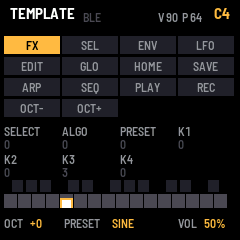
Provides the platform layer above the hardware (screen, drawing and fonts, panel and LEDs, audio, MIDI over USB and TRS, storage, a screen reader channel) so an app supplies only its own sound, screen and controls. The same app builds for the FM-1, a host simulator and a browser emulator. Bluetooth MIDI and WiFi are build options that cannot be combined on JieLi's libraries, since the chip lacks the RAM for both. WiFi and the default Bluetooth stack need JieLi's SDK libraries; an own stack taken from Optimist (build option ble_stack = "own") links none of them and also offers pairing, connecting to Bluetooth MIDI devices and Bluetooth audio to headphones and speakers. With the own Bluetooth and own WiFi stacks together (wifi_stack = "own") a firmware can have both, with an access point mode (MODE AP), opt-in Ableton Link, which makes the firmware GPL-3.0-only as a whole, and an optional USB network adapter (usb_net) that runs Link and the app's UDP over the cable. The repository includes a skill file for moving a Felucca-based firmware onto it, which only works for firmware that keeps nothing of Felucca beyond what felucca-bsp and fm1-base already carry. A companion service, switched on in fm1.toml, lets a computer or the repository's companion web page ask a firmware what it is and has, copy, replace, back up and restore the app's files and edit its parameters over SysEx. The template is a flashable firmware with its own installer and emulator page, tagged as firmware rather than tool for that reason. The README calls it beta, says the platform interface may change before 1.0 and names CTL-1 and a WiFi radio firmware as the two firmwares built on it so far.
Install notes
Clone with --recursive and build the template with tools/build.py (JieLi toolchain and AC79 SDK needed), then install with tools/fm1_install.py. The template's site also has a Chrome or Edge installer, a browser emulator and the template package, which that installer can replace with M-VAVE's V15 file that you download yourself. Back up before flashing.
Version history
| Version | Date | Notes |
|---|---|---|
| main @ e4863fa | 2026-11-27 | No tagged releases; this is the latest commit. Since the previous row the live mirror can read an app's project first (LOOM-8 is the first user), backups can keep restoring older images when an app adds objects at the end of its list, and LICENSING and DESIGN now say a GPL firmware may use all of fm1-base, with linking JieLi's libraries the part that needs a GPL-3.0 section 7 permission. |
| main @ f4bd9c5 | 2026-11-27 | No tagged releases; this is the latest commit. Since the previous row an update or UBOOT ends a SysEx stream an app left open, the SD card read-ahead interrupt moves to the input scan's priority after USB MIDI input went silent at the old one, the audio_ahead option drops a half only when a render is missed anyway, the app can choose the 396 MHz clock at each start, and build.py can use the open pi32v2 LLVM toolchain in place of JieLi's. |
| main @ 3039770 | 2026-11-26 | No tagged releases; this is the latest commit. Since the previous row, the own WiFi stack with its access point mode and opt-in Ableton Link is merged, a USB network option (usb_net) is added, packages can carry extra read-only regions (fm1.toml extras), app_steps and app_clear_top are added, the updater stops swallowing a SysEx frame another handler took, and the build gains a PLAT_SPARE section for RAM left over from the reset-kept records. felucca-bsp is updated to fdd709f. |
| main @ 2bb8e74 | 2026-11-22 | No tagged releases; this is the latest commit. The newest commits add a larger app slot through app_end and app_clear_end in fm1.toml, with an update loader that clears what the other slot kept, and an optional sliced flash erase so saves need not silence the sound, a smaller RAM page for the app store, and README text on the bigger slot and m-bootloader's MIDI mode. They also turn interrupts off around the clock restore and update felucca-bsp. Before those, commits add SD card streams for an app, with an optional read-ahead in SPI1's interrupt and two clock options that are off by default, and make a mirror frame that finds the ring full send at the host's pace and add an events mode for a viewer that runs the app itself. They also shrink the boot decoder, add a build-budget file and bump dependencies. Before those, commits pin and harden the toolchain container (FM1B_ISOLATE=1 runs a tool with the tree read-only), let the build tools use Docker or podman, add an osv-scanner script with supply-chain workflows and Dependabot, make the installer ask a device again for its whole identity after a slow first boot, which stopped a good install from reporting a short identity, and update felucca-bsp to cfaa97f. Before those, commits add an optional companion service (fm1.toml companion = true) that a computer or a new web page can query over SysEx for what a firmware is and has, and that lists, reads, replaces, backs up and restores the app's files and edits its parameters, over Web MIDI or the browser emulator. The template turns it on with its settings as a file, a build removes an old package before it starts so a failed build leaves none to install, and the capability reply names the crash history only in a build that has one. Before that, the newest commits bring the browser installer's m-bootloader from 2.3 to 2.4, which removed the Wipe user data item from its menu, and update felucca-bsp more than once. They also add a pinned toolchain fetch (tools/setup_toolchain.sh with a lock file) and a pinned Python environment, merge several pull requests, and make the SD card start end a transfer left open by earlier firmware. Before that, the package carries the app's resource region, so an install from a host that sends only the package (The Firmware Hub, M-UPGRADE) has the app's resources. Before that, an optional audio_ahead setting renders half the audio a block ahead, a cpu_clock setting can run the chip at 396 MHz instead of the 360 default (past the stock clock, tried on one FM-1), fm1.toml sets the input scan rate, the browser emulator can copy a session as a script for the host simulator, the installer tolerates the short identity reply right after the restart, and fm1pkg_make ciphers the head in flash.bin the way an FM-1's flash holds it. Before that, the own Bluetooth stack pairs with a Bluetooth MIDI keyboard that refuses its notes over an unencrypted link (a Roland FP-30X is the example) and retries later, with a 10 second give-up. Before that, felucca-bsp is updated again so USB audio input packets follow the I2S clock, and the template's manual says update mode is REC at power-on. Before that a usb_audio_channels setting (4, 6, 8 or 10) gives the USB audio input extra channels for the app, the bundled felucca-bsp is updated, the installer page runs again after a script error, and the identity reply no longer carries the flash ID, which stopped The Firmware Hub's installer from finding the unit. Before that the storage accepted the UC25HQ80 flash chip of newer units and the installers recognised M-VAVE's own V15 file. |