OpenVALive FM-1
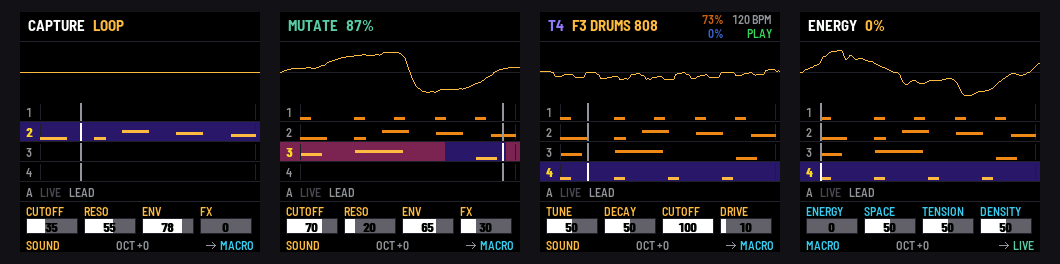
Live-first groovebox firmware for the FM-1: four synth or drum tracks with their own loops, a CAPTURE button that turns what was just played into a loop, loop editing, undo, scenes with a morph knob, hold-to-play effects and a Creative Engine.
by Tom-Rfid
- Distribution
- Browser installer (WebMIDI / WebUSB)
- Requires stock
- Any FM-1 firmware; the installer writes the package over it
- License notes
- The LICENSE file is the MIT text. The CORE repository's licence page says the firmware also contains fm1-base and felucca-bsp files (MPL-2.0) and three JieLi SDK files (Apache-2.0) that are downloaded at build time and not committed.
- Source
- github.com https://github.com/Tom-Rfid/OpenVALive_FM-1
- Homepage
- tom-rfid.github.io https://tom-rfid.github.io/OpenVALive_FM-1/
- groovebox
- looper
- sequencer
- drums
- synth-engine
- performance
- generative
- emulator
- controller-mode
- usb-midi
- usb-audio
Description
Each of the four tracks has its own loop length for polymeter, with a sample-accurate clock, swing and MIDI clock in and out. CAPTURE turns the last phrase played into a loop in time, even with the transport stopped, LOOP EDIT changes it note by note, and eight steps of undo and redo cover takes, captures, edits and creative changes. The Creative Engine mutates, humanizes, fills, simplifies, rotates, reverses and adds Euclidean patterns to a loop, and shows the amount before it is applied. Eight scenes store every sound and mute and one knob morphs between two of them. Stutter, filter, delay throw and drive effects last while a key is held. The sound is a virtual analog engine and a synthesised drum engine, with 29 presets in seven families including five drum kits, and the drum keys follow either the original tom layout or the General MIDI map. A CONTROL MAP menu assigns the knobs, and a SOUND EDIT page reaches every parameter, the modulation matrix and tempo-locked LFOs. MIDI comes in over USB and TRS and goes out over USB, with a controller mode and USB audio. The synth itself lives in the OpenVALive CORE repository (listed separately) and the target is built on fm1-base and felucca-bsp; a browser emulator runs the whole firmware. The project was called OpenLive until 19 November 2026, when it moved to new repositories and its release numbers restarted at 0.0.3. The README says it is not affiliated with M-VAVE.
Install notes
Use the project's browser installer in Chrome or Edge, or download the zip from a release and run FLASH-FM1.bat on Windows, or run fm1_install.py with the .fwsc. The browser installer can also write m-bootloader after the firmware, as an unticked option. The docs say to back up presets and projects first and to go back to M-VAVE's firmware with the Felucca web installer. For a unit that no longer starts, the README points to the author's jieli-usbkey-unbrick scripts, which open the chip's factory loader from a Raspberry Pi over the USB cable without opening the case.
Version history
| Version | Date | Notes |
|---|---|---|
| 0.1.1 | 2026-11-27 | Adds an SMK-37 card to the Firmware Hub listing; the firmware is 0.1.0's. |
| 0.1.0 | 2026-11-27 | The release page points to the changelog; it pairs with OpenVALive CORE v0.3.0 and carries a Windows flasher package. |
| 0.0.3 | 2026-11-19 | First release under the OpenVALive name, as package FM-1_023. Adds sound families, LOOP EDIT, a choice of drum key maps and recovery scripts. |