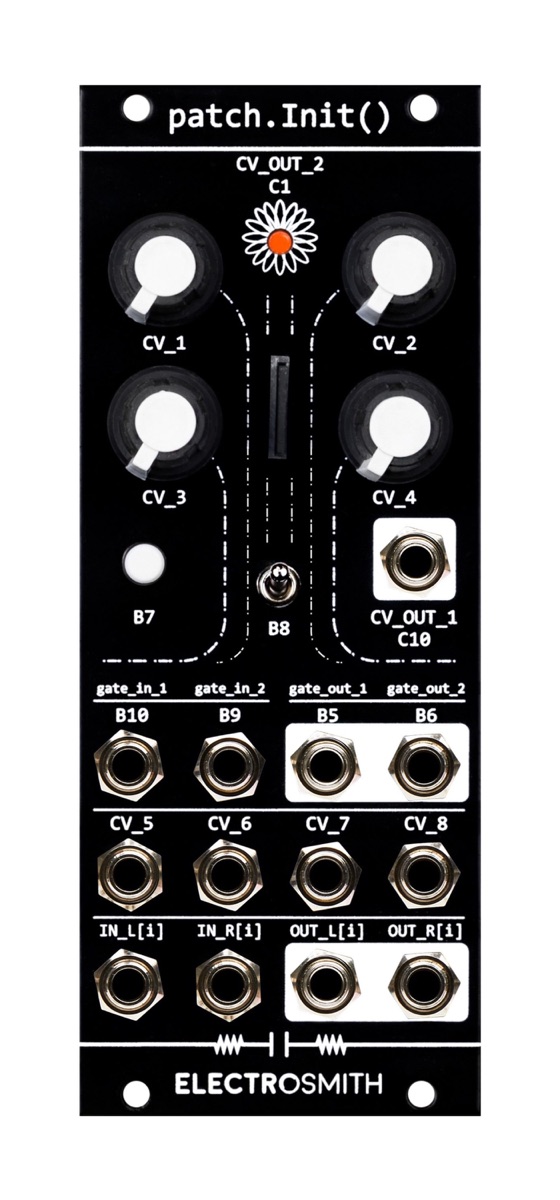
This entry covers hardware from Electrosmith built on its Daisy embedded audio platform, whose Daisy Seed module uses an STM32H750 processor. Daisy Patch is a Eurorack module with quad 24-bit audio I/O, Patch.init() is another Eurorack module on the platform, and Daisy Pod is a small desktop board with knobs, an encoder and buttons.
Platform
Electrosmith Daisy Seed and Patch SM (STM32H750, Arm Cortex-M7)
Early Daisy Patch ports by Erwin Coumans, including the CloudSeed reverb, a WAV granular player, a sample player and a Rings and Clouds reverb, collected as DaisyBouquet.
Neural amp modelling firmware for the Patch.Init that runs NAM A2-Lite captures from microSD, nineteen "not-amps" with one steer control each and a bank of networks trained on two hardware filters; Mirth Lite is the screenless build.
Adds a Filters bank, nineteen not-amps instead of twelve, a rearranged knob layout with a drive control, and conversion of .nam files copied to the card. Mirth Lite was released with it as mirth_lite-v1.1.0.
OpenWare port that turns Daisy hardware into an OWL device. Loads existing OWL patches (Pure Data, gen~, Faust) over SysEx; supports Daisy Patch, Bluemchen, Patch.Init() / Patch SM and Daisy Pod.
Drum module firmware for a stock Daisy Patch.Init, built on Mutable Instruments Grids with three synthesised drum voices drawn from a pool of ten models, a kit-roll toggle and four pattern banks.
Collection of small applets for Daisy Patch, including an FM VCO, a VCA, a noise source and waveshaping, each using a pair of CV and audio inputs and outputs.
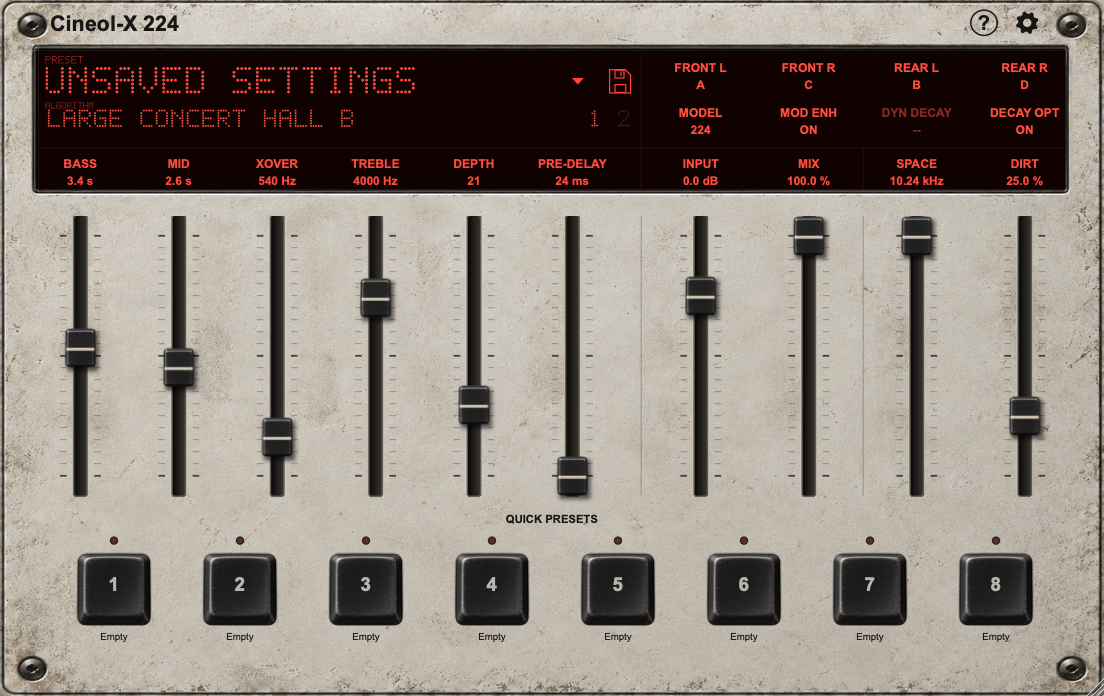
Daisy Seed or Patch SM with the public Daisy bootloader set up for a QSPI application at 0x90040000, plus your own Lexicon 224 v4.4 ROM1 to ROM5 files.
GitHub prerelease. Adds three original 224 programs, Room A, Constant Density Plate A and Chorus A, for 31 programs in all with the XL set. The 224 ROMs must be imported again to build the expanded cache that the new programs need.
GitHub prerelease. Limits Original 224 Plate pre-delay to its 107 ms maximum, fixes the maximum Attack and Depth values on the XL programs, and lets Original 224 Mod Rate and Depth keep independent settings.
GitHub prerelease. Adds a Clean setting with higher-precision arithmetic on all 28 programs, a Variation control for Dark Hall, extra controls on the original 224 pages and fixes to bypass, HF endpoints and the Rich Plate and Rich Split timing.
Mutable Instruments Braids macro oscillator for the Patch.Init: Joy has 48 models and a 64x48 OLED navigator, and Joy Lite is a screenless build of 16 models for a stock unit.
Daisy Patch.Init with the Daisy bootloader. Joy also needs a 64x48 SSD1306 OLED on the expansion header with the B8 toggle removed; Joy Lite needs the toggle fitted.
Multi-engine voice firmware for a Patch.Init() with an OLED, hosting a four-operator FM voice, an interval dual oscillator, a scanned-synthesis voice and a plain oscillator behind one shared panel layout, with the engine stepped by holding a button.
No tagged releases; this is the latest commit. Since the previous entry the commits redesign MultiOsc's panel (v2.0) so that B7 held for two seconds steps through the engines and pot 1 picks within one, add a power-up V/OCT calibration with a FAIL result, and fix B7 holds being read as taps (v2.1). The message says v2.1 is built but not yet flashed.
No tagged releases; this is the latest commit. Since the previous entry the commit gives each Patch.Init one shared V/OCT calibration, stored in QSPI flash, and moves MultiOsc to a boot-SRAM build so it can write it. The message says it was built on libDaisy v9 but not yet flashed or checked by ear.
Mutable Instruments Beads granular texture synthesizer on a stock Patch.Init, with four knobs on three layers, a freeze button, SEED and FREEZE gates and V/Oct calibration.
Modular firmware for Daisy Patch built from small modules called droplets, each usable full-width or split into left and right halves, with a menu to switch between them.
Diatonic quantizing arpeggiator for Daisy Patch that turns a V/oct root input into an arpeggio of the chord on that scale degree, with chord voicings, inversions and clock divisions.
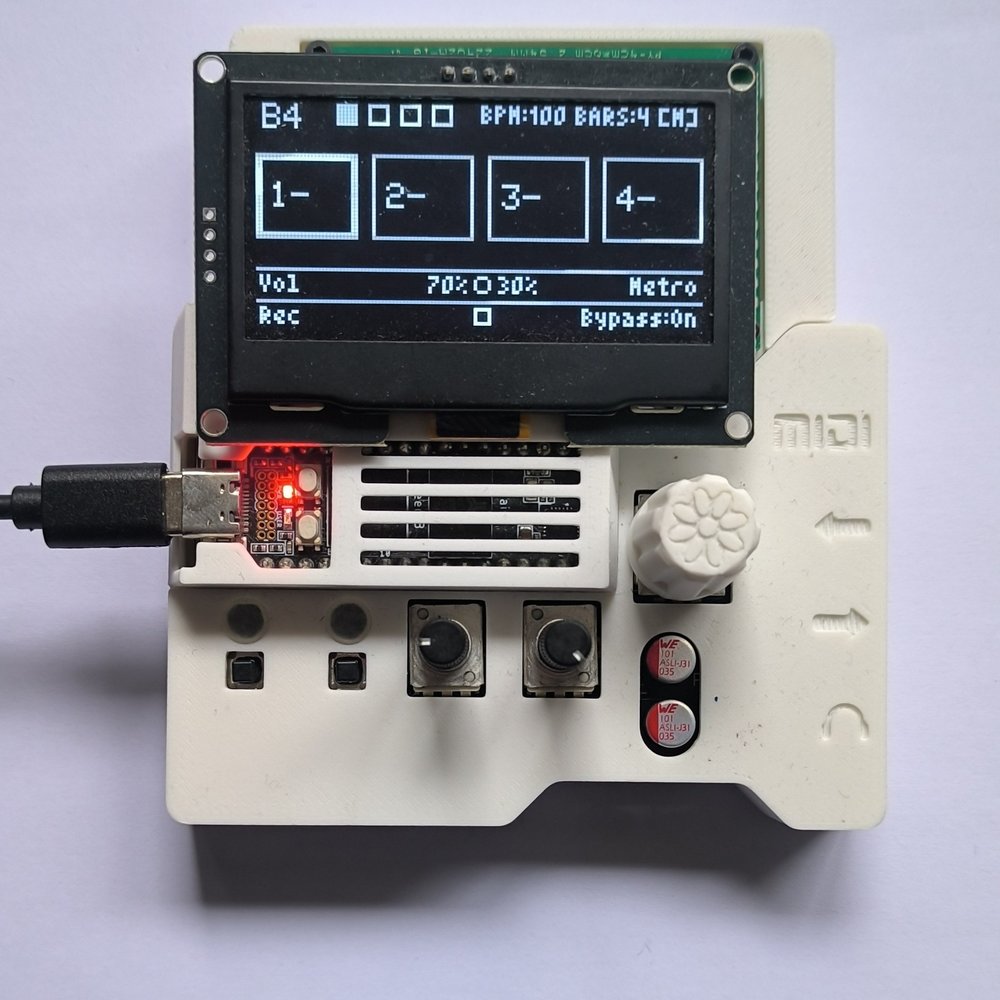
Multitimbral groovebox firmware for the Daisy Pod with a four-layer looper, DX7-style FM, granular, string ensemble, organ, supersaw and sampler engines, a MIDI sequencer, an I2C OLED menu and SD card storage.
Adds external MIDI clock with start, stop, continue and song position, standard controller CC numbers that turn the playing engine, and MIDI Learn for up to 32 mappings. The SD card template adds the quick-start and user manual PDFs and two demo songs.
Knobs that move a cursor or choose from a list act as soon as they are turned on arriving at a page, and the pickup on other knobs also catches a fast turn that sweeps past the on-screen value.
Adds Live FX, sixteen performance effects over the whole mix (repeats, stutter, reverse, tape stop, scratch, sweeps, crush, gate and throws) that can be held or latched and are captured by Live and Song export.
Sixteen-effect processor for a Patch.Init() with a 64 by 48 OLED, in four banks of reverbs, delays, filters and pitch or distortion effects, with CV on every knob and a global dry and wet control.
Two-voice algorithmic drum sequencer for Patch.Init() with energy, shape and axis controls, a config mode for clock division, swing, drift and accent, and CV on the four performance parameters.
Five Patch.init() firmwares by Gritwave, an amp simulator, a multi-effect, a dynamics processor, a wavetable oscillator and a noise and distortion unit, built from one C++20 repository.
Work-in-progress port of Mutable Instruments Plaits to Patch.Init() with all 24 engines of the final v1.2 firmware, including the chord engine, run from SRAM by the Daisy bootloader.
Port of Mutable Instruments Plaits to Daisy Patch, the first project in the Mutable Daisies series. Monophonic (low latency) and polyphonic (up to four voices) builds exist.
Oscillator processor for Daisy Patch with a two-output envelope generator, VCA, filter and multi-effect section holding reverb, delay, distortion and a DJ filter, controlled from an on-screen menu.
Waveshaping polyphonic synth written in Pure Data for the Heavy compiler, with eight voices, six waveshaping algorithms and a simplified control scheme for the Daisy Pod; also builds as a plug-in and for the web.
Port of Staffan Melin's OscPocketD polyphonic MIDI virtual analog synth to the Daisy Pod, with oscillator, filter and effect pages on the knobs and 16 save slots.
Fork of DaisyExamples with the author's own Daisy Pod programs added, including a DJFX effect suite, granular looper and time-stretch engines, and a performance looper modelled on a sampler's DJ effects.
Groovebox and looper firmware for the Daisy Pod, played by several people at once from a MIDI keyboard, pads and a guitar input, with retrospective capture, swing, send effects, eight scenes and a WebSerial companion app.
Supersaw oscillator for Patch.Init() that follows the reverse-engineered Roland JP-8000 algorithm with seven detuned saws, 24-bit fixed-point arithmetic and a pitch-tracked high-pass filter.
Reverb firmware for Patch.init() built from DaisySP algorithms, with send level, overdrive and modulation intensity, feedback and high-pass, and low-pass controls, plus a square-noise and AM LFO option.
Ten-voice additive synth for the Daisy Pod, each voice made of eight harmonics with harmonic balance, bitcrusher, envelope, shared filter, distortion and LFO, controlled mostly by MIDI.
Rust and Embassy stereo delay utility for the Daisy Pod that delays a radio feed by 0 to 170 seconds to line it up with a TV picture, with encoder control, a 14-segment display and a saved setting.
Four-playhead stereo looper for Daisy Patch with up to 60 seconds of loop, per-head speed, window, direction and pan, six reverb modes and tape-style fading on overdubs.
Additive synthesis voice for the Daisy Patch with 1V/oct fundamental and stretch controls, comb-style partial amplitude schemes, FM and sync inputs and separate outputs for fundamental and partials.
Daisy Pod adaptation of Dekrispator, a monophonic synth that plays itself with random patches, a 16-step random sequencer, FM, multisaw and additive generators and a chain of effects.
Drone machine for the Daisy Pod with eight drifting polyblep saw oscillators and delay, phaser and chorus effects, controlled by modes selected on the encoder.
Eurorack looper for the Daisy Patch that carries the Echoplex Digital Pro's live-editing functions (substitute, reverse, loop window, speed, crop and tile) as gestures and CV or gate patch points. A guitar-pedal target is in progress.
Flocking-simulation synth for Daisy Patch where up to 16 oscillator voices follow 3D boids, with position mapped to pan, frequency and amplitude, scale quantization and a reverb bus.
DX7-style FM drone synth for the Daisy Field and Patch.Init() that simulates six operators of the Yamaha DX7 sound chip, with algorithm selection and per-operator ratio and level controls.
Port of the ReverbSC stereo reverb to an early Daisy Patch prototype, built without the libDaisy library from its own startup, linker and hardware files.
TB-303 style acid voice for Patch.Init() built on the Open303 DSP engine, driven by CV and gate or USB MIDI, with saw and square waves, accent, slide and a drive stage.
Arduino sketch for Daisy Patch that models an Eventide H910 Harmonizer and delay, with a pitch-shifted left channel, a plain delay on the right and a mode switch on the encoder.
Collection of about 35 Pure Data patches for the Patch.Init() module, including synths, delays, drum and noise processors, with some used in the author's performances.
Granular synthesizer for the Daisy Pod that plays audio from an SD card or the line input, with a chord mode, Moog ladder filter, compressor and reverb.
Speech synthesizer for the Daisy Patch that runs the Commodore 64 SAM (Software Automatic Mouth) engine, with word slots edited on the encoder, six voice profiles and gate-triggered playback.
Virtual modular drum kit for the Daisy Patch, built from separate drum voices such as bass drum, snare, noise snare and FM drum, with a display screen and parameter editing.
Six-voice polyphonic MIDI synth for the Daisy Pod with a reverb, an NTS-1 style signal chain, and arpeggiator and sequencer code, still early in development.
Real-time granular synth for the Daisy Pod that plays WAV files from SD using only the Pod's two knobs and two buttons, with five colour-coded control pages.
Experimental Patch.init() oscillator patch with a triple and a single VCO, an envelope output and two gate outputs that run in a reverse or an independent mode.
Electrosmith's C++ hardware library for the Daisy platform, covering audio, ADC, MIDI, USB, SD cards, displays and board support classes for the Seed, Patch, Pod, Field and others.
Python compiler that turns Pure Data patches into C/C++ and framework wrappers, with a Daisy generator for Patch, Patch.init(), Pod, Petal, Field and three devkit layouts.
Electrosmith's C++ DSP library of oscillators, filters, envelopes, effects, drum and physical-model voices, used with libDaisy and also in plug-ins and VCV Rack modules.
Exports Max gen~ patchers as C++ for Daisy hardware (Patch, Pod, Petal, Field and Seed), builds them and uploads the result, with several gen~ apps selectable on one device.
Toolchain for designing a custom Eurorack module in C++, Faust or Max gen~ around a Daisy Patch Submodule, with a VCV Rack simulator and generated panel, PCB and firmware files.
Electrosmith's WebUSB DFU programmer for Daisy boards. The page flashes a user-chosen binary or a listed example such as Blink to a Seed in bootloader mode, and replaced an earlier JavaScript page whose source is in the repository.
Rust no_std embedded-hal board support package for the Daisy Seed in three codec revisions and the Daisy Patch SM, with audio, ADC, flash, SDRAM, SD card and OLED examples and a bootloader guide.
Rust hardware abstraction layer for Daisy boards with audio, GPIO, ADC, SD card, SDRAM, flash and USB MIDI support, plus examples such as passthrough, delay and blinky.