fm1-violioliolol
Physical-modelling string instrument for the FM-1 with no samples: 19 plucked and bowed instruments in four families, up to 12 voices, modal bodies and 16 user presets.
- Distribution
- Browser installer (WebMIDI / WebUSB)
- Requires stock
- M-VAVE stock firmware or another Felucca / fm1-base build
- License notes
- Stated in the README ("MIT licence") and in the SPDX header of the release workflow; the repository has no LICENSE file. Built on fm1-base and felucca-bsp, which are pinned as the base/ submodule and keep their own licences. No M-VAVE stock image is bundled.
- Source
- github.com https://github.com/profikid/fm1-violioliolol
- Homepage
- profikid.github.io https://profikid.github.io/fm1-violioliolol/
- synth-engine
- physical-modelling
- presets
- emulator
- midi
Description
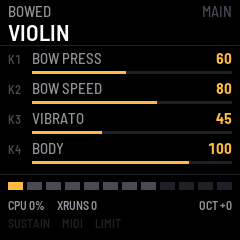
Every note is a vibrating string computed in real time. The 19 instruments cover finger, pick, slap, fretless and upright bass; nylon, steel, clean, driven and jazz guitar; violin, viola, cello and contrabass; and harp, mandolin, banjo, koto and zither. Plucked strings use extended Karplus-Strong waveguides with stiffness, pluck position, pickup position, buzz and five excitation styles. Bowed strings use a stick-slip waveguide with bow pressure, speed and position, and vibrato. A modal body is shared by all voices, followed by tone, drive and a limiter. Keys give velocity and pressure; MIDI covers pitch bend, mod wheel, volume, expression, sustain, pressure, the knobs on CC16-23 and program change. The 16 user presets store model parameters, not audio. Built on charlesvestal's fm1-base, with Felucca's board support code underneath. The README calls it experimental: it builds and passes the base's checks, but nothing has been verified on a physical FM-1, CPU load and polyphony on the unit are unmeasured, and the default polyphony of 8 is described as a guess. The project site has a browser emulator, a manual and a web installer.
Install notes
The README gives a web installer on the project site (Chrome or Edge over USB) and says to download the .fwsc from the latest release for the Firmware Hub or fm1-base's tools/fm1_install.py. The first GitHub release is 0.1.1; the workflow run for the v0.1 tag had failed. The source builds with sh build.sh and the JieLi toolchain. The README says the firmware does not touch the bootloader or the recovery path, that the stock firmware can be reinstalled the usual way, and that the installer offers the open m-bootloader as a separate opt-in box. docs/benchmark-procedure.md asks installers to measure CPU load and polyphony.
Version history
| Version | Date | Notes |
|---|---|---|
| 0.1.1 | 2026-11-13 | First GitHub release, with the .fwsc, the app binary and checksums. The notes call it experimental, built and tested in the simulator and native DSP tests but not measured on an FM-1, so CPU load and the default of eight voices are unverified. They list 19 instruments, plucked and bowed string models, and up to 12 voices. |
| 0.1 | 2026-11-11 | Git tag; no GitHub release page. |