TRIO
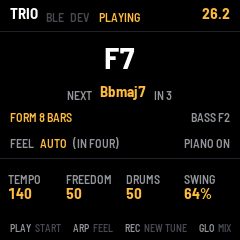
Jazz trio for the FM-1: you play the chords on the keys or a MIDI keyboard, and small neural networks on the chip name them, learn the form, and play a walking bass and swung drums, with a bass that can learn your line.
by Reytian
- Distribution
- Browser installer (WebMIDI / WebUSB)
- License notes
- LICENSE is the MPL-2.0 text; the fm1-base submodule in base/ is MPL-2.0 too. The weights were trained on FiloBass (CC BY 4.0) and JazzSAMBA (an MIT-style licence) and the bass's partials were measured in FiloBass's audio; neither dataset is in the repository, and CREDITS.md carries the attributions. A build links JieLi's Bluetooth libraries (Apache-2.0) copied from the AC79 SDK, which are not in the repository.
- Source
- github.com https://github.com/Reytian/fm1-trio
- Homepage
- reytian.github.io https://reytian.github.io/fm1-trio/
- neural-network
- generative
- chords
- drums
- synth-engine
- emulator
- bluetooth
- midi
Description
Four small networks of about 110,000 8-bit weights run in the main loop. One names the chord from the notes held, one guesses the next chord until the form is known, one picks the bass note for each beat and its pickups, and one plays the drum kit on swung triplets. After the chords come round, the screen shows the form length and the next chord, and the band keeps going round it when you stop playing. EDIT lets you play the bass yourself for a chorus or two, after which the FM-1 retrains the bass network's last layer on your line in about a second. The sound is an FM electric piano, an additive upright bass built from partials measured in recordings, a drum kit and a room. It takes USB, TRS and Bluetooth MIDI keyboards and has a browser emulator. It is built on fm1-base and felucca-bsp. The README says it was developed and tested in the host simulator and emulator and installs and runs on the FM-1, and that the networks' timing on the chip is estimated, not measured.
Install notes
Installer page in Chrome or Edge with the FM-1 connected by USB, or base/tools/fm1_install.py with the .fwsc from the releases page, run from a clone with its submodule. The installer page has a section for going back to M-VAVE's own firmware. Units sold since autumn 2026 carry a different flash chip that 0.1.1 supports and 0.1 does not; the release notes say 0.1.1 has not been tried on such a unit and point to the Firmware Hub's rescue page for a unit stuck on 0.1. Installing is at your own risk.
Version history
| Version | Date | Notes |
|---|---|---|
| 0.1.1 | 2026-11-05 | Adds support for the UC25HQ80 flash chip of newer FM-1 units, on which 0.1 kept saves in RAM only and refused updates, and moves to the current fm1-base so M-UPGRADE 3.11 finds it. The band is unchanged. Tested on a unit with the old chip, not yet on one with the new chip. |
| 0.1 | 2026-10-19 | First release. Two demo videos recorded in the host simulator are attached to the release. |