Ruido
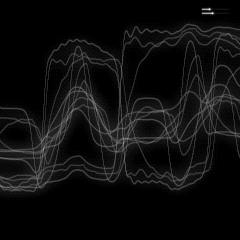
Four-oscillator drone synthesizer modelled on Schmitt-trigger oscillators, with a filter pair per oscillator, a scope on the screen and three pressure-keyboard layouts, meant as a sound source for pedals and modular systems.
- Distribution
- Prebuilt image you flash yourself
- Requires stock
- V15
- License notes
- THIRD_PARTY_NOTICES.md states GPL-3.0-only for the firmware, which links the Dinghy platform layer, itself built on Felucca, SLOOP and Skiff code. Terminus font is SIL OFL 1.1. Three unmodified JieLi bootloader and EQ blobs from the Apache-2.0 AC79 SDK are read at packaging time and are not stored in the repository.
- Source
- github.com https://github.com/miguelhd/ruido
- synth-engine
- oscillator
- filter
- lfo
- fx
- performance
- midi
- emulator
- drone
Description
Each of the four oscillators is a 4x oversampled Schmitt-trigger model with band-limited edges, capacitor tilt, thermal drift and a shared supply threshold, followed by its own 12 dB high-pass and 12 dB low-pass zero-delay filter pair in an MS-20 style. Knobs 1 to 4 map to oscillators 1 to 4, and the SEL button with SELECT switches between three keyboard layouts called Live Mixer, Circuit Lab and Rhythm Lab that use the key pressure sensors and LEDs. The engine also has eight LFOs, four stored scenes, a configuration menu, MIDI clock and transport input, and a live oscilloscope on the screen. The C++ engine is platform independent, with a macOS and WebAssembly simulator, headless tests and a separate FM-1 target built in Docker on Dinghy and felucca-bsp. The roadmap ticks the on-device bring-up work but ticks the check on a physical FM-1 for v0.7.0, and Bluetooth MIDI, a gesture looper and MIDI CC and program change input are planned for later versions.
Install notes
Download ruido.fwsc (package identity FM-1_312) from a release, or build build/fm1/ruido.fwsc with the Docker toolchain (make targets in the Makefile), then install it over USB with platforms/fm1/flash_fm1.py, which checks the package identity, size and flash chip before opening a MIDI port. The platform layer provides the Hold OCT- USB rescue mode, and make fm1-check runs the image in an emulator first.
Version history
| Version | Date | Notes |
|---|---|---|
| 0.8.0 | 2026-11-26 | Reworks the oscillators, overdrive and resonant filters, and removes clicks and dropouts when sweeping filters, driving hard, morphing scenes or layering keyboard effects. Adds INIT SCENE in the SAVE menu to reset one scene slot, and highlights every active voice when several knobs or keys are held. The package identity is FM-1_312. |
| 0.7.3 | 2026-11-23 | Improves the keybed LED feedback when morphing scenes, shows the firmware version on the boot screen and adds the user guide address to the About screen. |
| 0.7.2 | 2026-11-21 | Boots with the audio output muted until PLAY/STOP is pressed, adds SHIFT labels to the SEL keyboard maps and clarifies the SAVE and DELETE scene labels. |
| 0.7.1 | 2026-11-18 | Pressing PLAY/STOP to stop freezes the LFO, drift and other live motion, the scope and the 42 LEDs while knob parameters stay editable. Updates the Firmware Hub card text and preview. |
| 0.7.0 | 2026-11-17 | First release package, ruido.fwsc with identity FM-1_312. Four coupled Schmitt-trigger oscillators, filter pairs with overdrive, eight LFOs, three swappable pressure keyboards, scene storage and support for both the P25Q80 and UC25HQ80 flash chips. |
| v0.1.0 | 2026-11-14 | Git tag; no GitHub release page. |