RemoteFM1
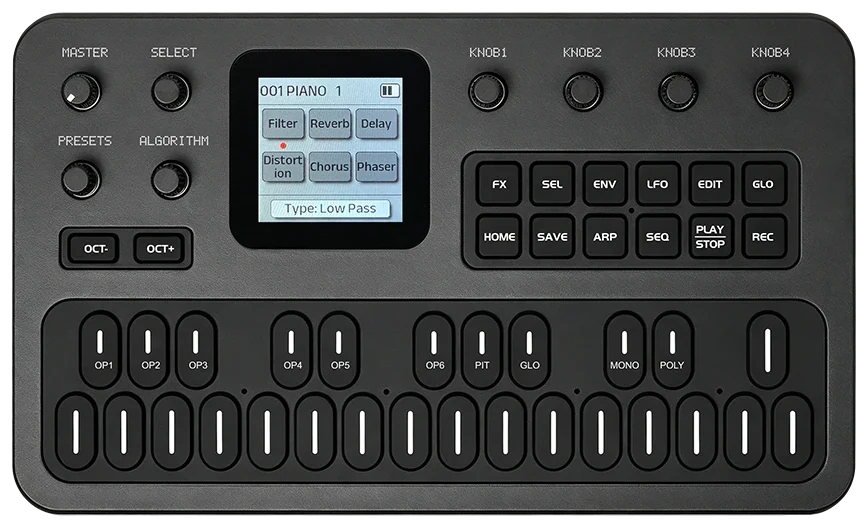
FM-1 firmware that is a standalone DX7-style instrument with a looper and MIDI controller modes, and also a remote panel: a host program on a computer can run an FM-1 firmware core and use the unit's keys, encoders and screen over USB.
by Quixotic7
- Distribution
- Browser installer (WebMIDI / WebUSB)
- License notes
- LICENSING.md puts the firmware (firmware/) under MPL-2.0 from 0.2, on fm1-base and felucca-bsp (MPL-2.0); the site, host library, tools and documents stay GPL-3.0-only. The standalone DX7's voice data, the Yamaha ROM cartridges, is Yamaha's and is not licensed by the project. The 0.1 and 0.1.1 firmware, built on TransitFM1 with parts from Felucca and SLOOP through Dinghy, stays GPL-3.0-only. The fonts are SIL OFL 1.1, and JieLi SDK files, including the Bluetooth libraries (Apache-2.0), are read from the user's own SDK checkout at build time.
- Source
- github.com https://github.com/Quixotic7/RemoteFM1
- Homepage
- quixotic7.github.io https://quixotic7.github.io/RemoteFM1/
Quality
Established
Mature and widely used.
- MaturityModerate
0.1 years · 14 releases · 366 commits
- PopularityModerate
★ 52 · 7 forks (3 active)
- VitalityStrong
366 commits last year · last activity 2026-11-21
- Issue healthModerate
1 closed / 11 open · 14 of 14 PRs merged
- InfluenceLow
0 catalog entries build on this
- CommunityModerate
2 contributors · bus factor 1
Data from GitHub, 2026-11-23. How ratings work.
- platform
- emulator
- usb-midi
- research
- synth-engine
- looper
- arpeggiator
- midi
Description
Rights warning: since 0.3 the firmware has Yamaha's eight DX7 ROM cartridges (256 voices) compiled in; the rights stay with Yamaha, and LICENSING.md says only the compiled firmware carries the data. Without a host, 0.3 plays on its own: an eight-voice DX7 engine (saadet's FM6) with the ROM cartridges and your own cartridges sent over SysEx (16 user slots in 0.3.1), velocity keys, scales, latch, an arpeggiator, a 16-loop looper, and a MIDI controller that sends notes and CCs over USB and Bluetooth, with MIDI in from USB, Bluetooth and the TRS jack. From 0.3.5 the settings page can turn the USB-C port into a USB MIDI host for a keyboard or synth, and the standalone sends MIDI clock and start/stop. A host session still takes the unit over as its panel. In that mode the device sends its input as plain MIDI and draws the screen from tiles sent back over USB SysEx, a vendor bulk interface or Bluetooth MIDI. A host program on macOS runs a firmware core such as ChoralRoot, Felucca or Melodee, using FM1VST's engine, and the sound plays on the computer. The stock firmware cannot run this way. From 0.3.6 a Bluetooth session can instead play the sound on the FM-1 itself, at lower quality. From 0.4 a separate Wi-Fi package connects the FM-1 to a Wi-Fi network so an Ableton Move running RemoteFM1 can use it as a panel. Since 0.2 it is built on fm1-base and felucca-bsp and plays the computer's audio through the FM-1's speaker or headphones over USB. It answers installers as itself (FM-1_52XXYYZZ); 0.1 and 0.1.1 were built on TransitFM1, which comes from Dinghy, and answered as V15. Any Felucca-family installer can write the next firmware over it.
Install notes
Installer page in Chrome or Edge over USB, or tools/fm1_install.py with the .fwsc; releases carry a USB plus Bluetooth package, a USB-only package and, from 0.4, a Wi-Fi package (FM-1_729000400). 0.2 answers as FM-1_52XXYYZZ, so an installer that does not know it yet may refuse it; any Felucca-family installer can replace it. 0.3.1 saves in the flash area where ChoralRoot and FIZZ keep their saves, so back those up first. FM-1s sold from late 2026 carry a different flash chip, which only 0.3.3 and later accept for saving and for updating from within RemoteFM1. The host program is built with CMake on macOS and expects an FM1VST checkout. The README keeps the FM-1 Transporter and MvaveFM1Unbricker at hand for recovery.
Version history
| Version | Date | Notes |
|---|---|---|
| 0.4.0 | 2026-11-20 | Adds a Wi-Fi package that puts the FM-1 on a Wi-Fi network so an Ableton Move running RemoteFM1 can use it as its panel without a cable, with a WI-FI settings row that lists and joins networks. The Wi-Fi package drops Bluetooth and USB audio to fit in memory; the default USB and Bluetooth MIDI package and the USB-only package are as before. A Move also works over its USB-A port with any package. |
| 0.3.6 | 2026-11-09 | Adds an optional mode, off by default, in which a session over Bluetooth plays the firmware's sound through the FM-1's own speaker and headphones and stops sending the screen. The release describes it as mono with a cut treble and about 150 to 200 ms of delay, tried only with a Mac. Saved cartridges, loops and settings stay. |
| 0.3.5 | 2026-11-08 | Adds a USB HOST setting that makes the USB-C port the host of a USB MIDI keyboard or synth (no power is supplied to it), sends MIDI clock and start/stop from the standalone, and releases held notes when a computer sleeps or the cable is pulled. |
| 0.3.4 | 2026-11-08 | Rebuilt on newer fm1-base and felucca-bsp with a flash driver that waits longer for slow erases, so the newer flash chip is handled by the base itself, and updates write only the changed parts of the flash. |
| 0.3.3 | 2026-11-04 | Accepts the second maker's flash chip found in FM-1s sold from late 2026. On those units earlier versions ran from RAM only, saving no cartridges or loops and unable to update themselves. Saved cartridges, loops and settings stay. |
| 0.3.2 | 2026-11-04 | No firmware change from 0.3.1. The first release built and signed on GitHub from the repository's source, and the version number and identity are new. |
| 0.3.1 | 2026-10-31 | Raises the user DX7 cartridges from 3 to 16, saves the 16 loops on the unit, adds a VELOCITY on/off setting and passes key velocity and pressure to hosts. Saves now sit where ChoralRoot and FIZZ keep theirs, so restore their backup when going back to them. |
| 0.3.0 | 2026-10-30 | Makes the FM-1 an instrument of its own without a host, with a DX7 engine, a 16-loop looper, an arpeggiator, scales and a MIDI controller over USB, Bluetooth and TRS; a host session still takes it over as a panel. |
| 0.2.3 | 2026-10-29 | Fixes recording from the FM-1's USB audio input, which came out mostly silent in 0.2.1 and 0.2.2. |
| 0.2.2 | 2026-10-28 | Bluetooth about six times faster and each screen change shown whole. |
| 0.2.1 | 2026-10-27 | Moves to fm1-base with Bluetooth MIDI and USB audio, answers as its own firmware identity instead of V15, and adds a USB-only package. |