Quasar
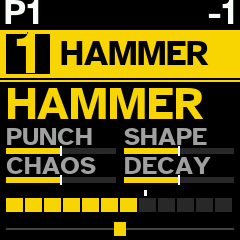
Six-track firmware modelled on the SOMA Pulsar-23, with 16 engine profiles over 147 sound families, internal routes, wreck and transform effects, a polymeter phrase generator and a performance mode, for experimental IDM.
by Nuno Zimas
- Distribution
- Browser installer (WebMIDI / WebUSB)
- License notes
- LICENSING.md states GPL-3.0-only for the firmware and its engine. Retained files keep their Felucca, SLOOP, Melodee and Bigorna notices. The website and logo are MIT, the fonts are SIL OFL 1.1, and the JieLi SDK files are read from your own SDK checkout at build time. The SOMA manual kept in the author's research copies is excluded from the repository.
- Source
- github.com https://github.com/nzimas/quasar
- Homepage
- nzimas.github.io https://nzimas.github.io/quasar/
- synth-engine
- drums
- sequencer
- looper
- generative
- fx
- performance
- midi
- fork
Description
Quasar models the Pulsar-23 as a whole instrument, with its bass drum, bass, snare and hi-hat circuits, shift register, LFO, clock dividers, effects processor and distortion, using an audio engine written from scratch for the FM-1 chip. Each of six tracks takes one of 16 engine profiles and draws sounds from 147 families, with four macros and four internal routes per sound. Pitch always follows the note played, so drums follow the scale. WRECK folds, rings and crushes every voice, TRANSFORM stacks drive and crush over random tracks, BREAK has ten ways of rearranging the pattern, and the phrase generator makes polymeters, ratchets and crossed Euclidean layers. There is also a looper, 16 patterns and sessions, MIDI learn and a PERFORMANCE mode. The control, sequencer and storage code comes from the author's Bigorna firmware, which is built on Tonitor, Felucca and SLOOP, and the dual-core start comes from Melodee. The README says the model follows the published behaviour of the Pulsar-23, uses no circuit values and has not been compared by ear with a real one. It does not state a hardware test, although its tools include a build that reports audio timing over USB MIDI. The second core renders about half of the sounding tracks.
Install notes
Browser installer in desktop Chrome, Edge or Opera over USB, then switch the FM-1 off and on once; or ./setup.sh and ./install.sh from the source on macOS or Linux. The README warns that an interrupted update can leave the FM-1 unable to start until it is recovered and that installing may void the warranty.
Version history
| Version | Date | Notes |
|---|---|---|
| main @ c82136e | 2026-11-03 | No tagged releases; this is the latest commit. The changelog calls build 3 the first public build. |