GRANA
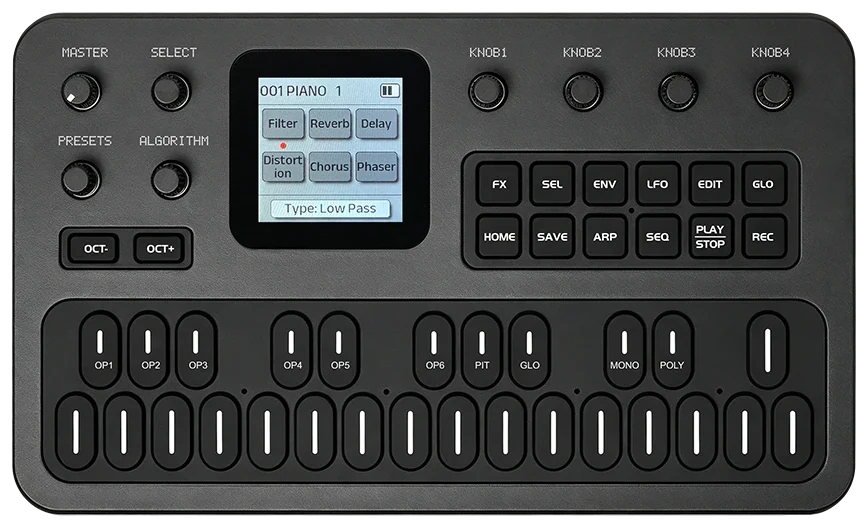
Granular sample player with four layers, lo-fi effects, an arpeggiator, a 64-step sequencer and 64 presets, installed from a browser editor that also loads your own samples. The interface is in Italian.
- Distribution
- Browser installer (WebMIDI / WebUSB)
- License notes
- LICENSING.md states GPL-3.0-only for GRANA's own files and for the code of Dinghy and Felucca it builds on. The Bluetooth stack from Optimist is GPL-3.0-only OR MPL-2.0, the Terminus font is SIL OFL 1.1, and jl-uboot-tool is MIT. Three JieLi SDK files (Apache-2.0) are read from the builder's SDK checkout and are not in the repository.
- Source
- github.com https://github.com/mongio/grana-fm1
- granular
- sampler
- sequencer
- arpeggiator
- fx
- reverb
- lfo
- midi
- editor
- web
- fork
Description
Rights warning: the rescue/ folder holds jl-uboot-tool unchanged, including a 24 KB binary JieLi USB loader (wl82loader.bin); the tool's own notes do not say where that blob comes from. Four granulation engines are selectable: Classic, Stretch, Formants and a Karplus-Strong Resonator. Up to four layers play together or split across the keyboard, each with its own pitch, start, area and pan. Grain size, density, spray, jitter and direction are adjustable, with a multimode filter, chorus, flanger, phaser, ring modulator and frequency shifter, tape echo, a plate reverb with shimmer, a compressor, two LFOs and key scales. The firmware holds eight synthesised stock sounds as its factory bank and has a separate 276 KB user bank that the editor sends over USB without reinstalling, for up to 48 samples at 22 or 11 kHz. A second build adds Bluetooth for BLE MIDI controllers such as the SMC-Mixer. MIDI over USB and TRS includes learn and clock in and out. It builds on Dinghy and the Felucca platform and, per its notes, was written with Claude's help.
Install notes
Download grana-editor-1.9.html from the release and open it in Chrome or Edge, which need Web MIDI and WebUSB, then press Installa with the FM-1 on USB. The page has a simulator and a Bluetooth checkbox. The .fwsc packages in the release hold the stock sounds, for other installers. Holding OCT- at power-on starts only the USB updater, and rescue/ has tools for worse cases. To go back, reinstall M-VAVE's firmware with its updater or the FM-1 Firmware Hub.
Version history
| Version | Date | Notes |
|---|---|---|
| 1.9 | 2026-11-25 | Redraws the screen with GRANA's own pixel font and four inline knob arcs, makes each granulation engine remember its four knob values when you switch away and back, and shows HOLD on the page row and in the header. The notes say it also holds 1.8.2, which was not published separately, and that it was tried in the simulator and on a real FM-1. Presets saved with 1.8.1 stay valid. The release holds a normal and a Bluetooth package and the editor page. |
| 1.8.1 | 2026-11-18 | Includes 1.8, which was never released separately. ALGORITHM picks a granulation engine (Classic, Stretch, Formants or Resonator, each with four knobs), the screen shows a battery icon, and six factory presets are new. The Classic engine gains RHYTHM (grains on a tempo grid), CHAOS, INTERVALS and GLISSANDO knobs, which do nothing at zero so old sounds are unchanged. The notes say the new engines were tried in the simulator and chip emulator, not on a real FM-1. |
| 1.7.1 | 2026-11-11 | Recognises the UC25HQ80 flash chip in newer FM-1 units, which earlier builds could not save to or update, in the firmware, the update loader and the USB rescue script. The flash driver waits out slow erases and writes, and the chip name shows on the opening and MIDI screens. Sounds and presets are unchanged; the notes say it was not yet tried on a real UC25HQ80 unit. |
| 1.7.0 | 2026-11-07 | Release page says only that the interface was refined. |
| 1.6.3 | 2026-11-02 | Editor only; the firmware is unchanged from 1.6.2. The editor can now save and open the user sample bank as a .grnb file. |
| 1.6.2 | 2026-10-31 | Adds a user sample bank sent over USB, 22 or 11 kHz samples, 12-bit output, a keyboard page with 15 scales, split mode and layer volumes. |