FM-1 in the browser (Ninjathune)
Browser emulator with one FM-1 panel that runs a selector of 132 open-source firmwares, 83 of them compiled natively, or FM-1+VA, a reimplementation of the stock instrument written from the manual.
by Ninjathune
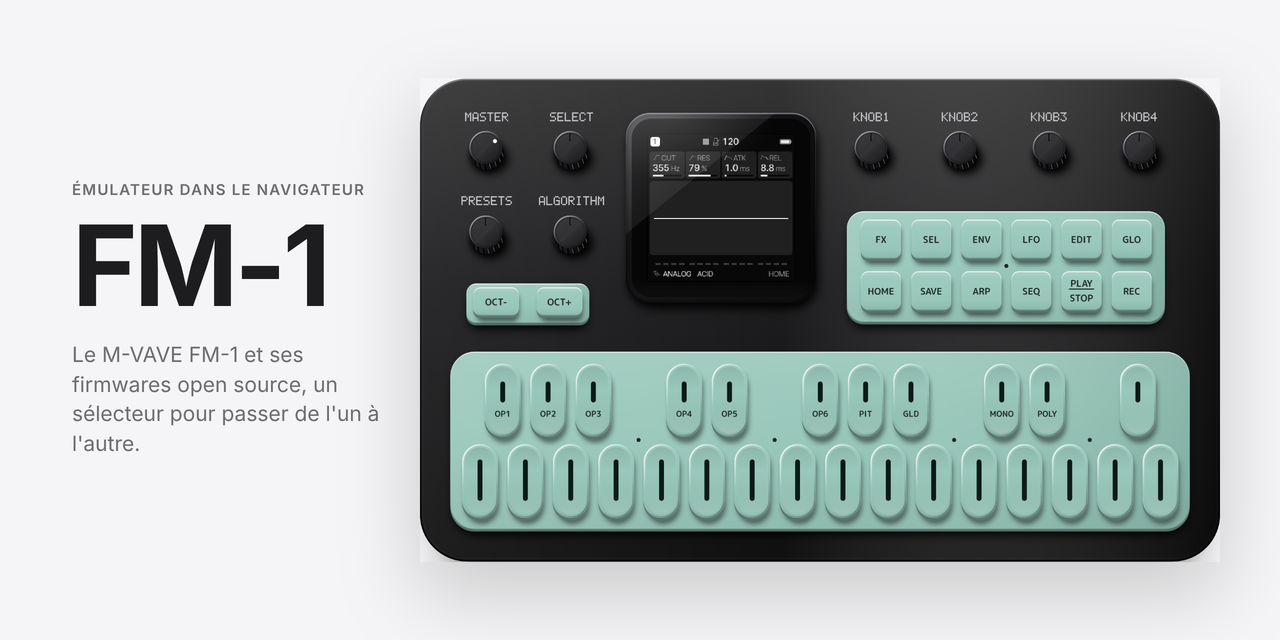
- Distribution
- Browser installer (WebMIDI / WebUSB)
- License notes
- MIT covers the project's own code. The bundled packages are the authors' published builds, checked by SHA-256 and each keeping its own licence in firmwares/catalogue.json. The bundled M-VAVE V15 package matches FM-1_015.fwsc licensed Apache-2.0 in m-vave/fm1_open (git blob ce49cc1595b67347c68a3ac7463017f9fa8c19dd).
- Source
- github.com https://github.com/Ninjathune-Human/Fm1
- Homepage
- ninjathune-human.github.io https://ninjathune-human.github.io/Fm1/
- emulator
- web-app
Description
Runs on computers, iPads and iPhones, with mouse, touch or stylus. An unsigned iPad app (FM1.ipa, rebuilt on each site publish under the rolling ipad tag) wraps the same page and is installed with Sideloadly. Most firmwares run unchanged on Joakim Eriksson's fm1-emu; 83 are compiled from source for the browser with no emulated processor. A local .fwsc can be opened, and a Duo page runs two FM-1s side by side, with a shared tempo clock if wanted. Presets and patterns are kept in the browser for each firmware, and a backup menu saves all of that to one JSON file and restores it. The repository publishes a verification report saying how each package ran. The interface and README are in French, with an FR/EN switch that also translates the manual, shortcuts and firmware help sheets.
Install notes
Open the page in a recent browser. Nothing is flashed to a device, and a local .fwsc stays on the computer.
Version history
| Version | Date | Notes |
|---|---|---|
| main @ 940e859 | 2026-11-24 | Runtime builds are published as releases; this is the latest commit. Since the previous row a note received over MIDI lights its key on the panel whatever the firmware, a keyboard's knobs can be linked to the panel's knobs, and endless encoders are recognised and followed in both directions with an adjustable speed. |
| main @ b2774bd | 2026-11-23 | Runtime builds are published as releases; this is the latest commit, which rewrites the README in French and English with a screenshot of the sample module and adds the module's icon to the selector. Since the previous row the sample module gains capture from a microphone, the FM-1 or a file, slicing at quiet points, a turntable and XY pad, macro assignment and sending samples to Pigeon, zp12 or a file. |
| main @ b5c4b1f | 2026-11-22 | Runtime builds are published as releases; this is the latest commit, where a native firmware without a new browser version keeps the one from the last deploy instead of falling back to the emulator. Since the previous row the project adds a sample module in the Duo page's frame B, with capture from the microphone, the FM-1 or a file, a turntable, an XY zone and pads, sending to Pigeon, zp12 or a file, sample backup, slicing at quiet gaps, trimming and a more responsive scratch. |
| main @ 0887b8b | 2026-11-22 | Runtime builds are published as releases; this is the latest commit, which adds a glissando to the on-screen keyboard. Commits before it add a tile grid with thumbnails for choosing firmware, native builds of AURORA, Chimera Vocal, Dungeon Tracker, Golf, PATCHWERK, Smileyface, Ruido, EVILGENIUS and Speak37 (the audit note says Ruido and EVILGENIUS have unlicensed content), named copies and backups of a firmware's memory, a firmware that starts when chosen with a loading message on the FM-1's screen, and a workflow that sends the iPad app to TestFlight. Before them, a commit runs SLOOP 3 natively through a generic loader for .rfm1 WebAssembly files and sorts the external firmwares. Before it, commits add an iPad app, an unsigned build that wraps the site in a WKWebView, passes the iPad's USB keyboard to the page over Web MIDI and is installed with Sideloadly, and make its GitHub Action more robust. Before them, commits add TastyWaves (with its patches kept), OPN-1, DINGHY and MIDIMON as natively compiled firmwares, let the MIDIMON monitor answer received MIDI, and keep the unlit-button glow from touching legends or colours. Before them, commits extend the Duo page's linked tempo to many more firmwares, among them the X0X and AMB families, ChoralRoot, MAKU and FiMba, and add AMB-1 and VECTOR37 as native builds. Since the previous row it adds an English interface and manual, and more firmwares (FMDj, SPAMPY, Scintilla, MNM-1 and others) among those compiled natively. Later commits add backup and restore of the browser's saved data, a tempo clock shared by the Duo page, Elixir, ECHOFIELD and GRAINE among the native firmwares, and LED brightness drawn from each firmware's own levels. Commits after that add eleven firmwares from The Firmware Hub, the native builds Argo, FRASIL, J6 and Mutable Dreams, a linked-tempo choice in the Duo page that offers only firmwares verified to follow the shared clock, and loading of a MIDI file into a SLOOP track. |