LUOGU
Peking opera percussion and jinghu accompaniment: 64 luogujing patterns, 18 banshi with guomen and five whole arias, with play-along scoring; menus in Chinese.
by Reytian
- Distribution
- Prebuilt image you flash yourself
- License notes
- The firmware code is MPL-2.0. app/dsp/tq_data.h, the arias, is CC BY-NC-ND 4.0 (non-commercial, no derivatives). Recorded strokes are CC BY 4.0 and fonts are SIL OFL 1.1 (LICENSES/, CREDITS.md). The two words in app/dsp/guo_snd.h come from a recording by Guo Degang and Yu Qian (Deyun Society) and are not under the project's licence.
- Source
- github.com https://github.com/Reytian/fm1-luogu
- Homepage
- github.com https://github.com/Reytian/fm1-luogu
- percussion
- sampler
- sequencer
- synth-engine
- ui
Description
Rights warning: the five arias come from the Jingju Music Scores Collection under CC BY-NC-ND 4.0, so the firmware that contains them may be shared but not sold or used commercially, and a hidden easter egg carries two sung words from a recording of a comedy performance whose rights belong to others.
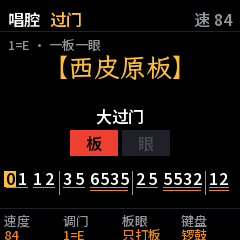
The firmware plays luogujing percussion patterns with their syllables lighting as they sound, and plays the jinghu, jingerhu and yueqin parts for eighteen banshi, so a user can sing with a band. In practice mode the user plays a chosen instrument on the keys or a MIDI pad and each stroke is scored as on time, early or late, and a follow-along mode makes the music wait for each stroke. The keys can also play the percussion or the string instruments in a chosen key. The sounds are recorded strokes from the Beijing Opera Percussion Instrument dataset, a synthesized large gong and filtered sawtooth strings. The author estimates the audio load at 35 percent of one core at most and has not measured it on the chip.
Install notes
Download luogu-1.0.2.fwsc from the releases page and run base/tools/fm1_install.py on it from a recursive clone of the repository, with mido and python-rtmidi installed. The release notes say M-VAVE's own firmware can be put back the same way. Versions up to 1.0.1 know only the Puya flash chip and cannot save or accept updates on FM-1s sold since autumn 2026 that carry the UC25HQ80; 1.0.2 handles both. The README says installing is at your own risk.
Version history
| Version | Date | Notes |
|---|---|---|
| 1.0.2 | 2026-11-05 | Adds support for the UC25HQ80 flash chip in newer FM-1s, on which earlier versions kept saves only in RAM and refused updates. Playing is unchanged. Tested on a unit with the old chip, not yet on one with the new chip. |
| 1.0.1 | 2026-10-23 | Moves the key-played note readout off the guomen notation on the banshi page. |
| 1.0 | 2026-10-22 | Adds the five whole arias, one job per knob and an easter egg. |
| 0.1 | 2026-10-22 | First release, without the arias. |