fm1-8p
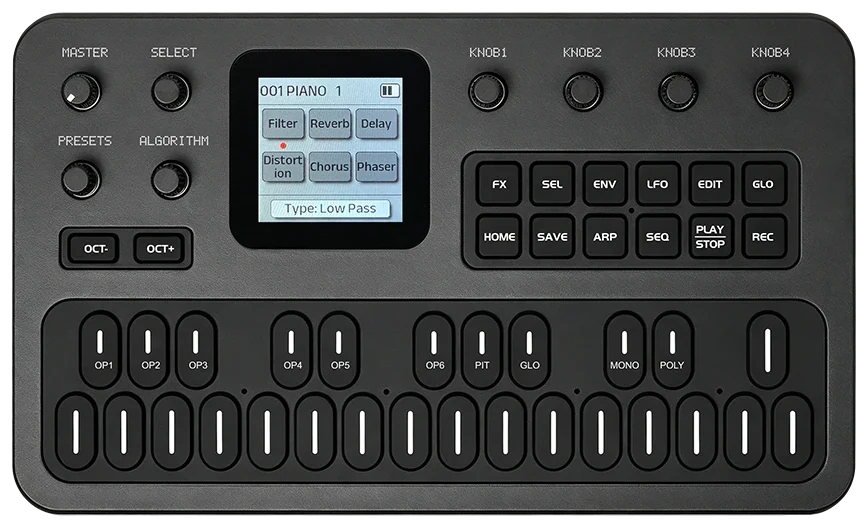
Rights warning: ships Roland JX-8P factory tone data. Polyphonic two-oscillator analog-style synth with a 24 dB lowpass, a highpass, an LFO and a chorus, built as an fm1-dock module or a solo package; its engine is fixed-point C.
by ericdahl-dev
- Distribution
- Browser installer (WebMIDI / WebUSB)
- Requires stock
- An FM-1 running fm1-dock for the .dock module; the solo .fwsc needs no particular firmware
- License notes
- The README says GPL-3.0 and LICENSE is the GPL v3 text; the engine's source headers say GPL-3.0-or-later. fm1-dock (GPL-3.0-only), the JieLi toolchain and SDK files and fm1-emu are fetched by the build at pinned hashes and are not in the repository. data/jx8p-factory-1-32.syx is the JX-8P factory bank as downloaded from a fan site, with no stated licence.
- Source
- github.com https://github.com/ericdahl-dev/fm1-8p
- Homepage
- ericdahl-dev.github.io https://ericdahl-dev.github.io/fm1-8p/
- synth-engine
- oscillator
- filter
- lfo
- fx
- presets
- midi
Description
Rights warning: the 32 patches are the factory tones of the Roland JX-8P, converted from a SysEx bank that the repository commits unchanged; the author says only patch data and names are used, with no Roland logos or panel art. The synth engine is written from scratch in plain C99 without floating point. Each voice has two oscillators (saw, pulse, square or noise, with octave, fine tune, pulse width and a mix), a resonant 24 dB lowpass with key tracking and its own envelope, a four-position highpass, an ADSR amplifier envelope, an LFO routed to pitch and pulse width, velocity, unison, sustain pedal and pitch bend, followed by a stereo chorus with three modes. The engine supports up to eight voices, and the FM-1 module plays four. The module runs from the keys and from MIDI, starts on tone 17, shows the patch on the screen and has a VCF page on the knobs. A CPU-test firmware times the engine on the device, and a guide for running it on a real FM-1 is in the repository; the README does not say that the synth itself has been run on one, only in the fm1-emu emulator. A desktop render tool turns a MIDI file into a WAV. The project is not affiliated with Roland or M-VAVE.
Install notes
No release exists yet; the project page (Chrome or Edge, Web MIDI) installs the build from main with fm1-dock's own installer, which the page marks as not yet tested on hardware, and carries the .fwsc and .dock for download. CI also builds the packages as artifacts, or tools/fm1-build.sh builds them from a Linux checkout. The .dock module goes onto an FM-1 that already runs fm1-dock, over USB without flashing. The solo .fwsc has fm1-dock's safety checks and rescue modes (OCT- at power-on for USB rescue, OCT+ for a safe start). The README advises keeping the stock V15 firmware for recovery.
Version history
| Version | Date | Notes |
|---|---|---|
| main @ 96ccac1 | 2026-11-28 | No tagged releases; this is the latest commit. Since the previous row the commits redesign the project page with a share card, add a skyline with a laser line on the play and boot screens in both themes, and use real FM-1 screens on the page. |
| main @ 340fc5c | 2026-11-27 | No tagged releases; this is the latest commit. Since the previous row the FM-1 module plays at the engine's own level, the LFO delay holds and then fades in as PG-8X 2.0.13 plays it, the DCO LFO depth is set to match PG-8X, and more sequencer start and stop fixes land. The build gains an FM1_NM setting for the module symbol check on macOS, and the scorecard is scored over several DCO-2 start offsets and caches each tone's score. |
| main @ e245c16 | 2026-11-26 | No tagged releases; this is the latest commit. Since the previous row, the repository gains a project page with the emulator playing the build from main and a browser installer, a workflow that lets The Firmware Hub build and publish v* tags, and a set of sequencer fixes for stop, play and followed-clock starts and for knob turns inside the sequencer. |
| main @ 00115f8 | 2026-11-25 | No tagged releases; this is the latest commit, which adds an oscillator test that checks SYNC being switched off drops a pending restart correction. The change is a test, not the firmware. |
| main @ 80b8d9b | 2026-11-23 | No tagged releases; this is the latest commit, which lengthens the scorecard's phrase notes to 0.7 s so every measured section reads 0.5 s or more. The change is in the project's measuring tools, not the firmware. |
| main @ d60eac8 | 2026-11-22 | No tagged releases; this is the latest commit, which puts the running, queued and stored patterns in one module with a single-writer handoff. |
| main @ 4661d71 | 2026-11-22 | No tagged releases; this is the latest commit. The newest commits move the gate's clip records and cache keys to one place, make the engine's mix gain a named constant, add one output stage from the voices to the DAC with the device's gain and generate the VCF FREQ cutoff curve from a single definition. Before those, commits let SAVE delete a user patch or pattern, start a stolen voice's new note at once from the voice's levels as PG-8X does, match the JX-8P DCO envelope at byte 1 to PG-8X's 5 cents, record the CPU gate rows as their mean and range, and make the scorecard and engine checks fail closed when a tool fails. Before those, a commit added a scorecard section comparing spectra with PG-8X's at the same level, and others add portamento that glides exponentially from the last note played as PG-8X's does, make the saw oscillator fall as PG-8X's so sync and ring modulation match it, and add a CPU gate row for each mode's high-note chord. Before those, commits make the VCA level change live mid-note and glide as PG-8X's does, free voices 80 dB below the output, remove a comb effect from the synced oscillator under the CLAV patch, add a CLOCK OUT setting that sends MIDI clock, start and stop while playing and passes on a followed clock, move a voice's filter behind one seam, add KEY TRANSPOSE in the SEQ view where keys or MIDI notes held while playing set the transpose, and test the MIDI clock's edge cases. Before those, commits add PG-8X's fastest amp attack on every key, step editing of bend and mod in the SEQ view with MIDI-in bend and mod taken into a written step, envelope fixes for key follow, a lazy envelope and a voice lifecycle interface, and a test that pins the screen's value text for every parameter. Before those, commits add a piano roll and step recording to the SEQ view, a boot screen with an LED sweep, and a lowpass filter modelled as two equal resonant sections. Before them, commits added per-step pitch bend and mod with jump or glide, saved with patterns, a pattern slot that loads, queues and saves from flash, a DCO-1 coarse tune, a program-change page, a key LED setting and a velocity curve for force-sensed keys. Before them, commits added a second theme called Night Panel, a settings record, a PLAY screen with the patch name and four performance knobs, a number jump that opens a parameter by typing its number after holding SEL, and user preset slots that a patch can be named and saved into and that load from flash. Before that the envelope curves, LFO rate and vibrato depth, chorus and high-pass positions are matched to PG-8X 2.0.13, and the filter envelope can follow envelope 2. Later commits match the oscillator sync and cross-modulation to PG-8X, set the oscillator mix levels and add output makeup gain with a soft clip, make the oscillator-pair renders cheaper, and add a script that checks a build still makes sound. |