FM Stud1o
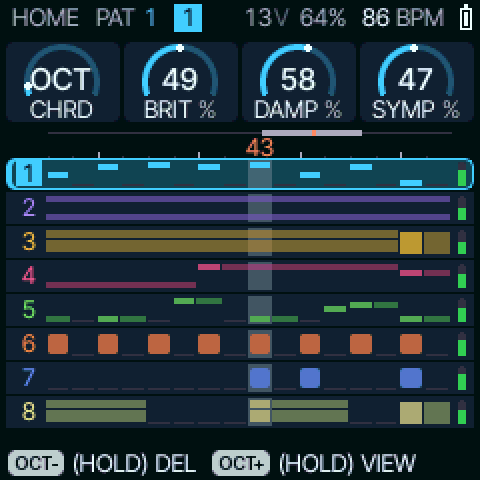
Felucca fork that makes the FM-1 an eight-track groovebox laid out like a DAW: channel rack, global patterns, piano roll, drum grid, song arranger, mixer and a per-track effect chain.
by MPASTEAU
- Distribution
- Build from source yourself
- License notes
- LICENSE is the GPL-3.0 text and LICENSING.md, inherited from Felucca, states GPL-3.0-only. Five engines and the shared DSP come from the MIT-licensed Felucca-Engines submodule, ported DSP (DaisySP, Rings, msfa) and fonts keep their own licences, and the drum and instrument samples are CC0 1.0. Every package holds three unmodified JieLi AC79 SDK files (Apache-2.0) that are not in the repository.
- Source
- github.com https://github.com/MPASTEAU/FM-Stud1o-FM-1-Firmware
- sequencer
- synth-engine
- fx
- performance
- drums
- sampler
- emulator
- fork
Description
Based on Felucca 1.6.1, whose engines, hardware layer and update loader it keeps. Each of up to eight tracks has its own engine, envelope, LFO, arpeggiator, scale, pattern and FX chain, and patterns are global across tracks. Patterns run up to 256 steps with chance, conditions, ratchets, nudge and parameter locks, and knob moves can be recorded as automation. A SONG screen arranges up to 16 sections, and the mixer has per-track pan, width and reverb send with mute and solo. Effects include sidechain ducking from other tracks, a four-band master EQ and held-key performance effects, and the GROWL engine for FM basses is this fork's own. Notes on MIDI channel 10 can strike the eight lanes of a drum track in order, and CC 117, 118 and 119 from a controller start, stop and arm recording. According to its latest commits, notes from MIDI in can step-enter into an armed, stopped sequencer, a controller's arpeggiator can write its chord into a step, CC 74 to 77 move HOME's four knobs with pickup, the MIDI pitch wheel can be recorded into patterns, and a LIVE mode, switched by holding PLAY, uses the keys to choose the pattern and to mute or set each track's level at the start of the pattern. Part of the rendering can run on the chip's second core. A browser emulator builds from the sources and starts with a demo song. The repository has no tagged releases and no web installer for this fork: the package is built locally and installed with the bundled Python script, and the author notes the public Felucca installer installs upstream Felucca.
Install notes
Build with the JieLi toolchain and AC79 SDK (BUILDING.md), then run python3 tools/fm1_install.py build/fm-stud1o.fwsc with the FM-1 on USB. Installing keeps saved projects. To return to stock, give the installer M-VAVE's official V15 file, or use M-VAVE's updater. If an install is cut off and the unit no longer starts, recovery needs FM-1-transporter.
Version history
| Version | Date | Notes |
|---|---|---|
| main @ e95c6bf | 2026-11-17 | No tagged releases; this is the latest commit. The newest commits drop the master limiter in favour of the soft clip alone, give USB audio a 1024-frame ring and 48 kHz packets, let a note held over the loop end play on in live recording, add a ruler on HOME for the longest pattern, MIDI IN CC1 vibrato and a spring-back joystick that closes the low pass and throws to delay and reverb. Before those, commits add a click output choice of sound, visual or both and a live click, flute and sax samples, and an Android app with a sampler that records, cleans and sends a take to a user slot, plus a hub that forwards USB MIDI controllers to the FM-1. Before those, Since the previous row, a pattern keeps its own arpeggiator settings, LIVE mode lets the white keys choose the pattern of every track and queues a pattern to start at the end of the selected track's pattern, pattern length offers 16 to 256 steps, and quantize is one setting for all tracks at 50 % by default. Later commits add a count-in that waits for the first note, live recording that keeps the keys as played in every voice mode, an 8-voice GRAIN, and a REC arm that follows the selected track; the LFO draw page is removed. The latest commits add volume-fade and filter-fade keys in LIVE mode, a count-in row set to off, on or note, removal of a drum lane's hits by holding its key while recording, and a pickup that takes a MIDI-turned HOME knob at 0 or 127. The newest commits record the MIDI pitch wheel into the pattern (while a key is held or the wheel is off centre), stop knob moves from recording as automation outside the AUTOMATION page, clear a drum lane with OCT- and a key or pad, and change how REC REPLACE ends held keys at the loop point. |