felucca-bsp
MPL-2.0 board support package for custom firmware on M-VAVE devices built around JieLi chips: clock, interrupts, flash, USB device and MIDI host, UART, timers, boot entry, update loader and FM-1 board code. No sound code or user interface.
- Distribution
- Build from source yourself
- License notes
- MPL-2.0 per file (LICENSING.md, NOTICE). Leo Kuroshita and keremimo confirmed it for the Felucca code and the USB code they own, and the USB host port has its author's permission. A fork of Felucca cannot move to MPL-2.0 by using this repository. JieLi's SDK (Apache-2.0) is fetched and checked by hash, not copied. Two files in chip/ (ble_rf_tables_v15.h, fm1_rf_cal.h) are Apache-2.0 and derive from the radio code of JieLi's SDK and M-VAVE's V15; the radio drivers come from Optimist by Henri David and are taken under MPL-2.0 from its dual GPL-3.0-only OR MPL-2.0 offer.
- Source
- github.com https://github.com/hugelton/felucca-bsp
- Homepage
- github.com https://github.com/hugelton/felucca-bsp
Quality
Foundational
Other projects build on it, or it is the maker's own open firmware or SDK.
- MaturityLow
0.1 years · 0 releases · 174 commits
- PopularityModerate
★ 25 · 22 forks (10 active) · 2 watching
- VitalityStrong
174 commits last year · last activity 2026-11-26
- Issue healthStrong
11 closed / 1 open · 30 of 38 PRs merged
- InfluenceModerate
3 catalog entries build on this
Derived entries: ABYSS, BOURDON, Doinua. - CommunityModerate
10 contributors · bus factor 1
Data from GitHub, 2026-11-23. How ratings work.
- platform
- sdk
- usb-midi
Description
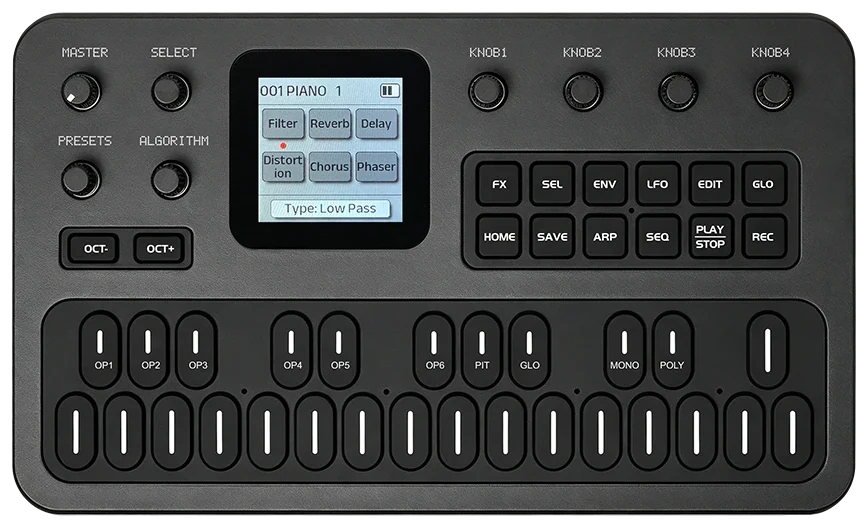
Split out of Felucca. It holds the chip layer shared across the family, a loader that builds as a RAM image, the update session in ota.c, USB with MIDI, serial and audio classes, an optional USB MIDI host (direct or through one powered hub, ported from Melodee), and the FM-1 wiring: LCD pins, key scan with optional velocity, ADC channels, audio codec lines and the headphone jack switch. Separate board folders cover the M-VAVE Galaxia guitar pedal (board PD49 V03) and, with audio, input and LCD headers, the Pocket Amp. Tools build update packages, install over USB-MIDI and rescue a unit that cannot start. The update loader has a fast install that writes only the sectors that changed, tools/fm1_rescue.py accepts the newer UC25HQ80 flash chip, and the USB audio input can be built with 4 to 10 channels. A hwtest example firmware exercises the screen, knobs, buttons, LEDs and USB serial. The README labels the second core, expanded flash and USB host as beta or experimental, a higher clock as a concept, and lists the SMK-37 Elite and Pro as planned without board support. Its chip/ folder also holds Bluetooth LE and BR/EDR radio drivers from Optimist, the radio's start-up tables and a calibration routine; fm1-base's own Bluetooth stack uses them; a Wi-Fi radio driver and its tuning facts (chip/fm1_wifi.h) serve fm1-base's own Wi-Fi stack. An optional CDC-NCM USB network adapter (FELUCCA_NCM) is off by default. fm1-base, CTL-1 and a WiFi radio firmware build on it. Some macros still carry the FELUCCA name.
Install notes
A base to build on, not an end-user firmware. Build with the JieLi toolchain and SDK files fetched by tools/get_sdk.sh, and install packages with tools/fm1_install.py. The safe hwtest image excludes the experimental parts. Flashing is at your own risk.
Version history
| Version | Date | Notes |
|---|---|---|
| main @ fdd709f | 2026-11-26 | No tagged releases; this is the latest commit. Since the previous row, it adds a Wi-Fi radio driver with its tuning facts for fm1-base's own Wi-Fi stack, an optional CDC-NCM USB network adapter (FELUCCA_NCM, off by default), and loader support for extra read-only regions that a package writes into the flash windows outside the app and data areas, with tests for power cuts and flash failures. |
| main @ 2bd9dbe | 2026-11-22 | No tagged releases; this is the latest commit. Since the previous row, the loader lets a firmware move the end of its app area up to 0xE0000 (FL_APP_END) with a slot switch and steps, with the defaults unchanged. The flash code gains an optional sector erase done in short windows so that a long erase no longer holds the CPU, off by default, and an install test now reads the flash only after the loader has exited. |
| main @ 2600dc6 | 2026-11-21 | No tagged releases; this is the latest commit. Since the previous row, the USB code gains a mirror pump that sends screen-mirror packets at the host's pace, an optional real-time MIDI path that sends clock ticks at once, a set of USB audio options that are off by default (host clock, 24-bit, capture and others) and a fix for a SETUP that arrives before a stall is serviced. The SD hardware header gains an SPI1 receive interrupt and a hard-driven clock option, the hardware test accepts the UC25HQ80 flash chip, and the rescue script still recognises a head whose isd_config.ini another tool rewrote. |
| main @ cfaa97f | 2026-11-20 | No tagged releases; this is the latest commit. Since the previous row, a USB host that does not read no longer loses SysEx answers, so the device keeps them and no longer flushes the MIDI IN FIFO every 50 ms, while notes, clock and mirror frames that wait are still dropped. |
| main @ 2a5af3d | 2026-11-18 | No tagged releases; this is the latest commit. Since the previous row, the USB host treats a bulk MIDI endpoint that declares a high-speed size as 64 bytes at full speed and resets a device that does not answer, both for an Elektron Digitone II. The device side gains an optional USB serial number, drops MIDI IN data to a host that does not read, and gets UI LED levels in fm1_input, a per-board update staging area and record name in ota.c, an SD card definition for the LCD's SPI1 and a faster disk mode. |
| main @ fbc254d | 2026-11-16 | No tagged releases; this is the latest commit. The latest commit makes tools/get_sdk.sh default to JieLi's Gitee mirror because the GitHub SDK repository is gone; just before it, the update loader takes an app's resource region from the package (a res.bin entry), so a host that serves only the package, such as The Firmware Hub or M-UPGRADE, installs an app's resources too; it leaves saves alone and a failure there never fails the install. |
| main @ d18879b | 2026-11-11 | No tagged releases; this is the latest commit. Since the previous row it sizes the USB audio input's packets from the FM-1's crystal rather than from the ring's fill level. |
| main @ e36cb7c | 2026-11-10 | No tagged releases; this is the latest commit. Since the previous row it adds a fm1_clock_pll1 call for choosing another PLL1 multiplier with restore and kHz readout, and sets the input scan tick rate with FM1_INPUT_HZ (10000, 5000, 2000 or 1000). |
| main @ e79a1f8 | 2026-11-08 | No tagged releases; this is the latest commit. Since the previous row it adds a Pocket Amp board folder with audio, input and LCD headers, and the rescue tool now explains how to reach update mode on a unit that still boots. |