CS-1
Yamaha CS-80-style polysynth sound module for dawless rigs: eight two-channel voices, the manual's preset tones, ring mod, delay, phaser and plate reverb, played over TRS or USB MIDI.
by twochannels
- Distribution
- Browser installer (WebMIDI / WebUSB)
- License notes
- Stated in LICENSING.md. The platform code is Felucca's (via Dinghy), the dual-core audio worker comes from FM-106 and the key sensing from Velo; the font is SIL OFL 1.1.
- Source
- github.com https://github.com/twochannels/CS-1
- Homepage
- twochannels.github.io https://twochannels.github.io/CS-1/
- synth-engine
- oscillator
- filter
- fx
- reverb
- delay
- midi
- velocity
- emulator
Description
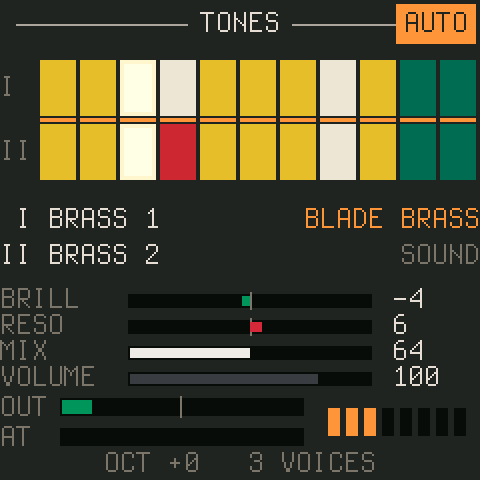
Each voice has two channels with a VCO, series high-pass and low-pass filters, a sine after the filters, filter and amplitude envelopes, and velocity and key pressure read from the FM-1's own keys. Performance controls include a sub oscillator, ring modulator, portamento, an initial pitch bend and the SELECT encoder as the ribbon, with an auto aftertouch curve, MIDI learn, a CC map for the Novation Circuit Tracks and clock sync for sequencer use. It has 52 sounds (22 tones read from the CS-80 manual's charts, classic recipes and eighteen converted from presets of the CS-80 V plugin with the authors' own names) and 32 user slots. The second core runs as an audio worker, taken from FM-106. The project site has a manual, a browser emulator and a web installer.
Install notes
Web installer on the project site in Chrome or Edge, or tools/fm1_install.py with the .fwsc. Holding OCT- at power-on starts a USB update mode. M-VAVE's updater or the FM-1 Firmware Hub's return-to-official option restores stock. User presets sit in their own flash sector and survive a reinstall.
Version history
| Version | Date | Notes |
|---|---|---|
| 0.3.2 | 2026-10-22 | Installing another firmware over CS-1 works again on units with an older flash head. |
| 0.3.1 | 2026-10-17 | Fixes a pop after each key on sounds with a deep chorus. |
| 0.3.0 | 2026-10-17 | Fixes seven sounds that played an octave low, voice stealing, portamento, reverb hiss and tape delay ticks. |