Compás
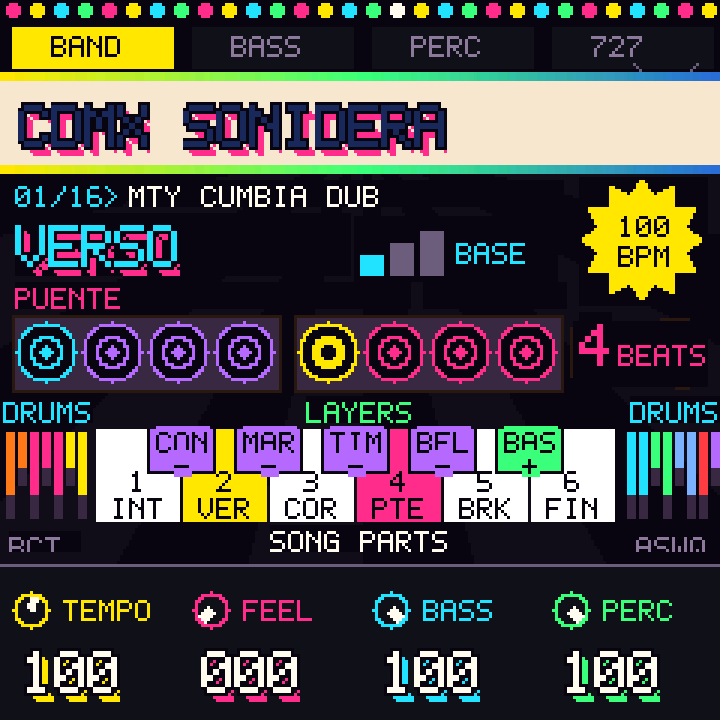
Compás is a bilingual Latin rhythm section for the M-VAVE FM-1: 38 source-labelled groove studies, 6/8 and 12/8 support, cued song parts, TR-727 percussion, bass, effects, persistent shows and a browser editor.
- Distribution
- Browser installer (WebMIDI / WebUSB)
- License notes
- LICENSE is the GPL v3 text and LICENSING.md states GPL-3.0-only. The Felucca board support is pinned from upstream under GPL-3.0-only, and the USB MIDI driver, updater and browser installer modules come from BB1 BAND r85 under the same licence. LICENSING.md says the fifteen TR-727 recordings are owned by the Compás author and released under the same terms. Most written songs are arranged from U.S. public-domain printed editions; Juana Quilina (CC BY-SA 3.0), La Adelita (CC BY 4.0) and La Valentina (CC BY-SA 4.0) keep their editions' licences. The Kumbia Kit sounds and patterns come from Oficina de Sonido's Hanan Cumbia, based on Bleep Labs' Bleep Drum, used under CC BY-SA 3.0. The JieLi SDK SPL, configuration and EQ data in the release package are Apache-2.0.
- Source
- github.com https://github.com/TexasRADIO/compas-firmware
- Homepage
- thebigbeat.app https://thebigbeat.app/compas/install/
- Community
- drums
- sequencer
- performance
- synth-engine
- emulator
Description
Compás plays drums, bass and hand percussion as a band. Six song parts sit on the centre white keys; a cued part waits for the phrase, counts down the beats and comes in on the boundary, and ALGORITHM sets the next phrase to base, lift or break. The bass plays ensemble lines for each style or switches to an acid voice, and conga, maraca, timbal and bell layers are switched in and out from the black keys. A 727 page puts fifteen TR-727 percussion recordings on the pads with a rhythm bank, a sixteen-step editor, live recording and roll, and a KUMBIA page plays the four sounds and four patterns of Oficina de Sonido's Hanan Cumbia on their own or layered over the band. Version 1.3 has 38 source-labelled groove studies. The nine new ones cover Mexican Sureste, Pará, north-coast Peru, a Costa Chica 6/8 accompaniment and a 12/8 bell and block study. The README calls them accompaniment studies rather than claims to reproduce a whole regional practice, and their source notes mark published reductions, authored support, proxy voices and studies still awaiting local musician review. Compound-meter studies show dotted-quarter BPM while MIDI clock stays at 24 PPQN. Kumbia gets a LEVEL / NIVEL knob from 0 to 100, with OCT−/+ setting its sample clock in Hz, and the final digital output conversion is restored to full scale, a 6.02 dB gain correction. ROOM reverb, tempo-synced ECHO, GLUE compression, MIDI clock out and the Sideman reference carry over from 1.2. Written songs arranged from printed editions play from THE SHOW on the GLO page, with a melody guide, hold, coda and transpose, and Rebajada slows the whole band to 60 % with the pitch. Supported shows, user rhythms and Kumbia settings are kept across power-off in a CPS6 journal, which a firmware update clears. Big Beat Editor in desktop Chrome or Edge reads and edits tempo, feel, groove, energy, key, clave, the six band lanes and effects over USB MIDI. The English and Spanish packages hold the same bilingual instrument and differ only in the language shown at first boot; GLO and ALGORITHM switch it live. A browser player on the project site runs the same audio engine. History: version 1.0 (2026-11-08) had 29 groove studies and 28 written songs such as La Paloma, Cielito Lindo and Siboney, and lost the set list and user 727 rhythms at power-off. Version 1.1 added the KUMBIA page, whose settings reset at power-off, and 1.2 added the effects and the Big Beat Editor adapter.
Install notes
Use the author's installer page in desktop Chrome or Edge with the FM-1 on USB, and keep the cable connected through the write. Choose English or Español there; the release also carries compas-1.3-en.fwsc and compas-1.3-es.fwsc, and the firmware identity stays FM-1_92210003. A firmware update clears the CPS6 journal that holds shows, user rhythms and Kumbia settings, so export the show with Big Beat Editor before installing. The 1.3 qualification says the package writes only the application area (0x4000–0x92FFF) and a staging area, leaving the boot head and device identity untouched, and that the hardware recovery route shown by the installer does not depend on Compás. To return to official firmware, give an unchanged M-VAVE FM-1 package to the installer's return section. For 1.3, physical installs of both packages with transport, editor and MIDI-clock checks passed, and a return to a compatible installed firmware was verified. The exact 1.3-to-stock-V15 round trip, the panel knob and save/power-cycle checks, analogue output measurement and regional musician review are still open. The FM-1's mask-ROM rescue is the fallback.
Version history
| Version | Date | Notes |
|---|---|---|
| 1.3 | 2026-11-24 | Nine more groove studies for 38 in all, 6/8 and 12/8 support, a Kumbia LEVEL / NIVEL knob and OCT−/+ sample-clock control, a 6.02 dB correction to the final digital output conversion, shows, user rhythms and Kumbia settings kept across power-off, and editor build 13. The English and Spanish packages are byte-for-byte promotions of 1.3-rc.4 and differ only in first-boot language. |
| compas-v1.2-editor.1 | 2026-11-16 | Compás 1.2 with an editor adapter for two-way USB editing from the Big Beat Editor in desktop Chrome or Edge, in English-default and Spanish-default packages. |
| compas-v1.2 | 2026-11-16 | Adds ROOM reverb, ECHO with musical time divisions and GLUE, with effects settings linked to each song, in English and Spanish packages. The notes say the English package completed a physical install and playback and USB checks. |
| 1.1 | 2026-11-08 | Adds a fifth page, KUMBIA, with four sounds and four patterns from the Hanan Cumbia drum machine (CC BY-SA 3.0), with drive, decay, pitch and sample clock knobs, and a layer mode over any Compás groove. Its settings reset at power-off. The 727 sound bank is stated to be the author's own recordings. |
| 1.0 | 2026-11-08 | First release, with 29 groove studies, 28 written-song arrangements, the 727 percussion mode and English and Spanish packages. |