lsdj-album
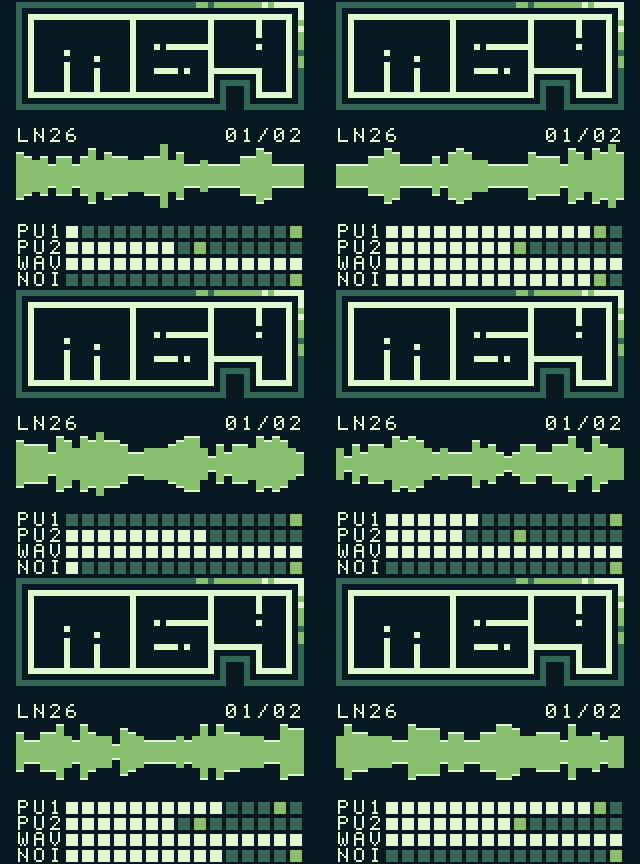
Builds a stand-alone Game Boy album ROM from the songs in an LSDj save, with a custom logo, song names, a level-meter and waveform visualizer and next and previous song buttons.
- Distribution
- Build from source yourself
- Requires stock
- LSDj ROM and save file, supplied by the user
- License notes
- The LICENSE file is the GPL version 2 text with no "or later" wording, although the README says "GPL-2.0-or-later, like lsdpack". lsdpack's own license is GPL-2.0-only, so the file is followed here.
- Source
- github.com https://github.com/M64GitHub/lsdj-album
- recorder
- player
- export
- visualizer
- album
- lsdj
- open-source
Description
lsdj-album records each song in a user's LSDj ROM and save with a fork of lsdpack, then builds an MBC5 ROM that replays the recorded sound register writes. The ROM shows a logo converted from a PNG, the song name read from the save, LED-style meters for the two pulse channels, wave and noise, and a scrolling waveform. A moves to the next song, B to the previous one, and songs advance when they end. Each song needs an HFF command at its end, or a global length limit can cut it. The README tests it with LSDj 9.3.9, which needed changes in lsdpack because LSDj 9 drives its sound engine from the timer interrupt. The repository holds no LSDj ROM and no songs. The result runs on a Game Boy flash cartridge or in an emulator, in DMG mode on Game Boy Color and Advance. The README credits Claude as a co-author.
Install notes
Needs RGBDS 1.0, CMake, a C++ compiler, Python 3 and make. Clone with --recursive and run make SAVE=path/to/lsdj, which gives album.gb; flash it to a cartridge with the cartridge's own tool or play it in an emulator. The LSDj ROM and save are never modified, because recording runs on copies. Nothing runs on the console except the finished ROM.
Version history
| Version | Date | Notes |
|---|---|---|
| main @ e29a121 | 2026-11-19 | No tagged releases; this is the latest commit. |