eurorack-mi-sgnir
Firmware for Rings (Mutable Instruments)
Slim source tree and audio-update releases of Rings firmware at a pinned upstream commit, with frequency locking, octave snapping on the frequency knob, a stricter calibration gesture and Schliere, a third bank built on a long chain of allpass filters.
by m9dfukc, Émilie Gillet
- Distribution
- Prebuilt image you flash yourself
- Requires stock
- Stock Rings with the audio bootloader
- License notes
- The LICENSE file is MIT with copyright to Émilie Gillet for the upstream Rings firmware, stmlib and the audio bootloader, and to m9dfukc for the modifications. The workbench repository is MIT as well.
- Source
- github.com https://github.com/m9dfukc/eurorack-mi-sgnir
- Homepage
- github.com https://github.com/m9dfukc/sgnir-workbench#readme
- physical-modeling
- modes
- performance
- calibration
- allpass
- open-source
Description
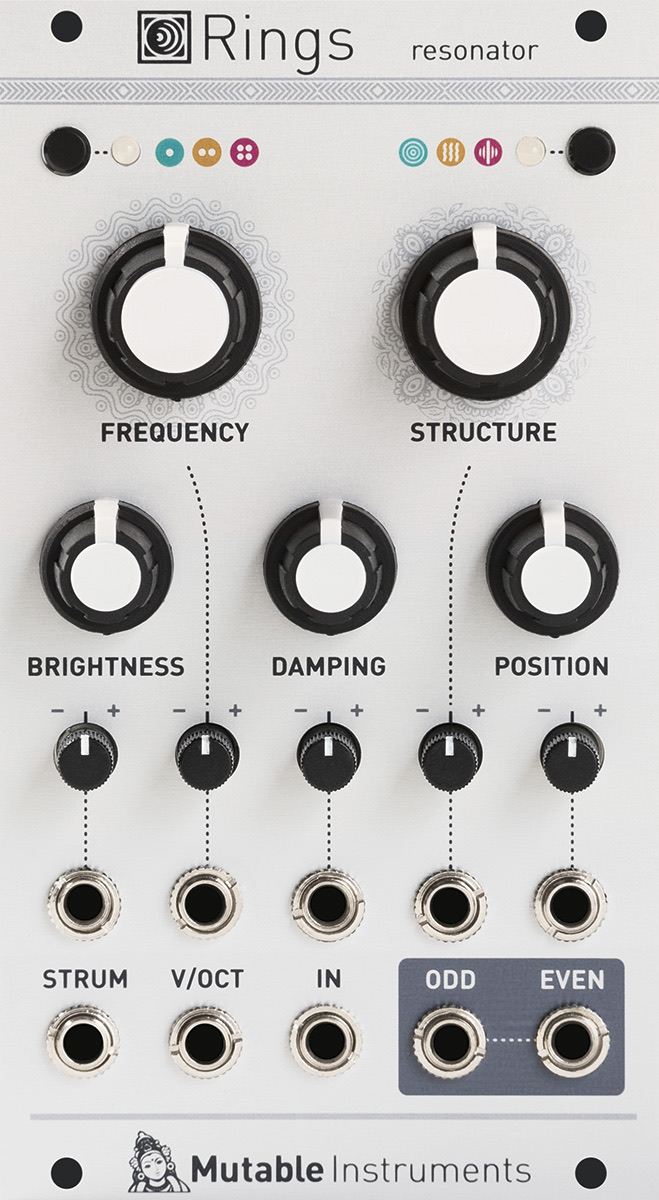
A snapshot of only the folders the Rings firmware needs, with stmlib and the audio bootloader vendored, so a clone builds without submodules. It is not a GitHub fork of the upstream monorepo. Changes on top of the unmodified base are separate commits. Holding both buttons for a short time toggles frequency locking, and while locked the frequency knob becomes an octave switch; the idea comes from Lyle Mills's alternative firmware. Calibration now needs both buttons held for six seconds, and the CV zero points are applied only when calibration succeeds. The new settings use formerly unused bytes, so settings saved by stock firmware are kept. Schliere, a third bank, is a chain of second-order allpass filters with feedback ported from the author's OWL patch, in a 61-stage variant S (48 kHz or 96 kHz feedback path) and a 98-stage variant L, selected with the right button. The README still says the differences from stock are not yet tested on hardware, and reports CPU load measured on a module on 2026-11-21. Releases are built by GitHub Actions and include the WAV for the audio bootloader, a raw .bin for SWD and checksums. The author's companion repository, sgnir-workbench, holds the planning notes, research on Rings forks and flashing options, the Schliere reference sources and Python tools for the audio bootloader's encoding; it is not a firmware itself. The name avoids the Mutable Instruments module name, as the company asked forks to do.
Install notes
Play the release's sgnir-<version>.wav into the IN jack through the audio bootloader: hold the left button at power-on, set FREQUENCY near noon and play the file from the start. The raw .bin is for SWD only. To build from source, use an Arm GNU toolchain (the README used 12.2.Rel1) and the makefile's bin target, which gives build/rings/rings.bin at address 0x08008000. The bootloader is not part of the application image, so a failed install is retried by entering bootloader mode and playing the update again, and the official Rings WAV goes back the same way.
Version history
| Version | Date | Notes |
|---|---|---|
| v0.3.0 | 2026-11-21 | Changes the Schliere excitation, so the noise burst becomes a mallet pulse, a pitched ping is added and the strummer runs in the bank, exciting on a V/OCT note change when STRUM and IN are unpatched. The release page itself only covers installing the WAV; this is from the tagged commits. |
| v0.2.0 | 2026-11-21 | Adds Schliere L, a 98-stage chain as a second variant cycled with the right button, and cuts the Schliere processor load by about a quarter. |
| v0.1.0 | 2026-11-20 | First release, with frequency locking, the stricter calibration and the Schliere bank as a third bank. |