NIBBLE
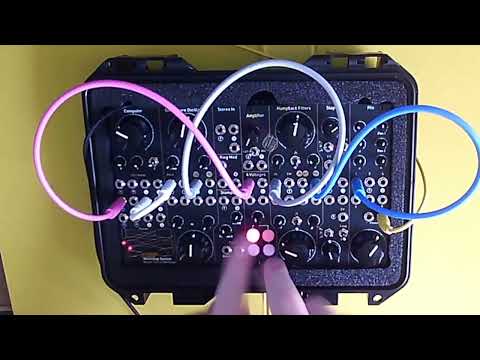
Firmware for Workshop System Computer (Music Thing Modular)
Turns the Workshop System's mysterious four buttons into tools to make melodic lines and lo-fi drum loops.
- Distribution
- Prebuilt image you flash yourself
- Source
- github.com https://github.com/TomWhitwell/Workshop_Computer/tree/main/releases/63_Nibble
- Homepage
- computer.musicthing.co.uk https://computer.musicthing.co.uk/programs/63-nibble/
- Synced from
- upstream metadata, raw.githubusercontent.com https://raw.githubusercontent.com/TomWhitwell/Workshop_Computer/main/releases/63_Nibble/info.yaml. Corrections belong upstream.
- keyboard
- quantiser
- scale
- drums
- looper
- sequencer
- four-voltages
- cards
Description
Turns the Workshop System's mysterious four buttons into tools to make melodic lines and lo-fi drum loops.<br><br>
Patch one output of the FOUR VOLTAGES module into CV In 1, teach the card which voltage each button combination produces, and the ten combinations become ten degrees of a scale (MELODY) - or a lo-fi drum kit with a looper behind it (PERCUSSION), chosen by holding the momentary switch at power-on. The left LED column at boot means Melody, the right column Percussion.<br><br>
SETUP: use OUTPUT 1 of Four Voltages with its knob at about twelve o'clock. That gives ten well-spread, reliably separable voltages. The knob position matters - it moves all four outputs at once, and towards either extreme several combinations collapse onto nearly the same voltage.<br><br>
Four buttons is four bits is one nibble.<br><br>
THE PROBLEM IT SOLVES: Four Voltages does not return to a rest voltage when you let go - the output sits at the last-pressed button's level. Releasing A+B leaves the voltage sitting exactly where pressing A alone would put it, so a naive design fires a spurious note every time you lift a finger. NIBBLE ignores that one specific level, and only that one, until the voltage moves somewhere else.<br><br>
The payoff is the way you play it: HOLD one button and TAP the others. Hold C, tap A for one sound, tap B for another, indefinitely, with no ghost notes. The held finger is a bank select and the tapping finger plays.<br><br>
Hold the momentary switch for two seconds to calibrate - ten steps, each confirmed by a tap, with the LEDs laid out in the same 2x2 as the buttons so the display is the instruction. Calibration is deliberately NOT saved: the Four Voltages knob changes every voltage it makes, so a remembered calibration would be a wrong one.<br><br>
The combinations play scale DEGREES rather than pitches, so the voltage only ever decides which combination you pressed - move the Four Voltages knob, re-learn, and the same buttons give you the same notes back. Twelve scales on Knob Y, ordered dark to bright.<br><br>
Hold the momentary switch at power-on for PERCUSSION (called DRUMS in the source; the default mode is MELODY, called KEYS). There a SINGLE button is a shift rather than a sound and only pairs trigger, which is what lets you hold one button and tap the others to repeat a hit as fast as you like - percussion is mostly repeated hits on the same drum, and a keyboard reading of the buttons cannot do that.<br><br>
TWELVE voices, not six, because holding A and tapping B is a different gesture from holding B and tapping A. Those close the same switches and give an identical voltage - press order is not in the signal - but the level the voltage came FROM is the button that was already down, and latching that recovers the ordering for nothing.<br><br>
THE KIT, all synthesised rather than sampled, which is why one knob can reshape the whole thing: kick (62Hz, swept), deep kick (50Hz), snare (190Hz), snappy snare (230Hz), closed hat, metallic hi-hat, open hi-hat, crash, cowbell (1500Hz), and three Simmons-style toms whose pitch falls exponentially rather than linearly - the "pew" that a linear sweep cannot produce.<br><br>
Laid out for the hand: HOLD C and a right hand has closed hat, snare and kick under three fingers, which is a whole beat without moving. HOLD D is the tom row for fills. A and B carry the colour and the crash.<br><br>
A four-bar event looper whose overdub is lossless because it records events rather than audio, clockable from Pulse In 1, a DJ filter whose movements can be recorded into the loop, and a click track on Pulse Out 2.
Install notes
Copy the UF2 onto the Computer's program card (RP2040 bootloader drive).
Version history
| Version | Date | Notes |
|---|---|---|
| 1.11.4 | 2026-08-08 | Version and date from the card's info.yaml. |