CardenzaHAL
Tool for Cardenza (203 Systems)
Official ESP-IDF hardware layer and SDK for writing Cardenza firmware, covering keys, key LEDs, screen, audio, microphone, SD card and USB, with a browser simulator.
by 203 Systems
- Distribution
- Build from source yourself
- License notes
- No LICENSE file for the repository itself; the licenses folder only holds the notices for the bundled 203 Launcher code (MIT) and HarmonyOS Sans bitmaps. The readme states no licence for the HAL.
- Source
- github.com https://github.com/203-Systems/CardenzaHAL
- Homepage
- cardenza.203.io https://cardenza.203.io/community/develop
Quality
Foundational
Other projects build on it, or it is the maker's own open firmware or SDK.
Counts as first-party: an official project or one by 203 Systems.
- MaturityLow
0.1 years · 0 releases · 157 commits
- PopularityLow
★ 2 · 0 forks
- VitalityStrong
157 commits last year · last activity 2026-11-29
- Issue healthModerate
0 closed / 0 open · 7 of 7 PRs merged
- InfluenceModerate
1 catalog entry builds on this
Derived entries: CardenzaSynth. - CommunityModerate
2 contributors · bus factor 1
Data from GitHub, 2026-11-23. How ratings work.
- official
- sdk
- library
- esp32
- simulator
- cli
Description
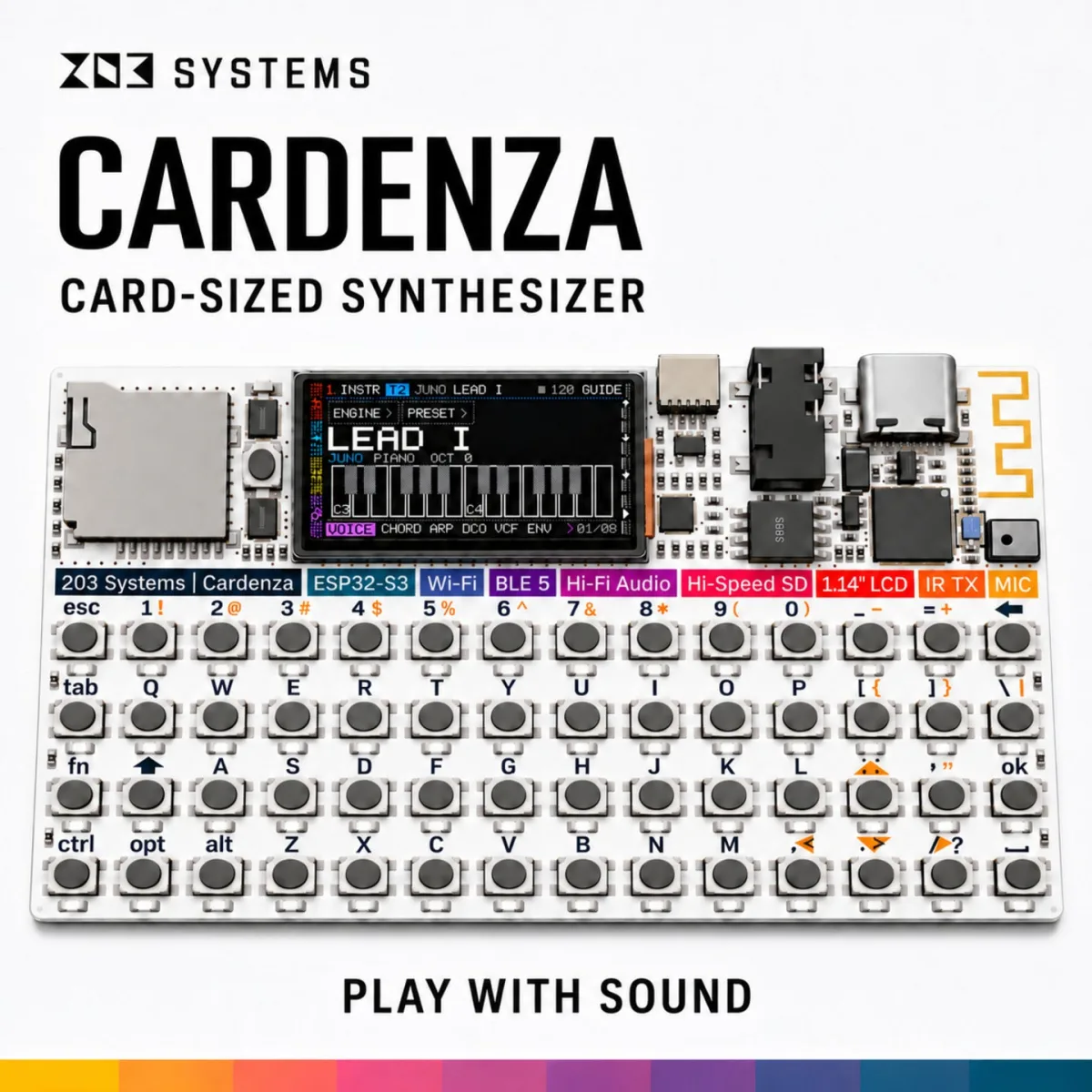
CardenzaHAL is the ESP-IDF component that every Cardenza firmware uses to reach the hardware, including the stock CardenzaSynth. It initialises and exposes the 56-key matrix, the per-key LEDs, the 240 by 135 ST7789 display, the audio codec for output, the PDM microphone, the SD card and the USB device (MIDI, audio, HID and a system channel), and adds the system menu that opens on the HOME key. The application keeps its own rendering, key mapping, audio processing and main loop. The repository also holds a firmware project template, a build tool that checks the environment first, host tests, example projects and a web target that compiles a firmware to a WebAssembly simulator. Developer documents cover project layout, the 203.json file, forks and publishing to the 203 community.
Install notes
Needs ESP-IDF 5.3.5 or later and, for publishing and flashing, 203-CLI. The readme gives 203cli new to start a project with the HAL as a Git submodule, tools/cardenza.py build to build it, and 203cli flash to install it on a Cardenza through the 203 Launcher. Never run idf.py flash on a Cardenza, which erases the Launcher and every firmware it installed.
Version history
| Version | Date | Notes |
|---|---|---|
| main @ 9940d7c | 2026-11-29 | No tagged releases; this is the latest commit. Since the previous entry the commit makes the I2S audio output default to interleaved stereo, with the README and examples updated to match. |
| main @ 8a9e81d | 2026-11-24 | No tagged releases; this is the latest commit. Since the previous entry the commits add a frame presenter that sends only changed screen regions in the panel's scan order, USB HID inputs (keyboard, media keys and gamepad), an opt-in USB drive that lends the SD card to a computer, a USB network adapter mode, a screen stream over WebUSB for recording, USB fixes for sleeping hosts, screenshots in every firmware (HOME + space saves a PNG to /sdcard/screenshot), and microphone gain set by the firmware instead of the board settings. |
| main @ eccf874 | 2026-11-23 | No tagged releases; this is the latest commit. Since the previous entry the commits add board settings (volume, limit, brightness, key lights, mic gain and language) in the HOME menu and over USB, and give every firmware one SD card layout, /sdcard/Apps/<AppName> with the Launcher's files in /sdcard/Launcher, with MigrateAppDir moving an older firmware's folder there. |
| main @ 9597136 | 2026-11-20 | No tagged releases; this is the latest commit. Since the previous entry the commits rename the 203c tool to 203cli in the build check, cardenza.py, the publish action and every document, and make the web simulator save screenshots of the screen alone and answer screenshot messages. |
| main @ 354f452 | 2026-11-20 | No tagged releases; this is the latest commit. Since the previous entry the commits make every firmware build require 203c and stop with install instructions without it, add a USB development channel so a computer can query a running firmware, add key cap legends in keyboard/legends.h, document the Cardenza's 16 MB of flash, and make builds print 203c update notices. |
| main @ be1b9b0 | 2026-11-19 | No tagged releases; this is the latest commit. Since the previous entry the commits make the presence service fit beside a synthesiser, with Wi-Fi allocations in PSRAM and a request made only when it fits, and fix a firmware freezing on its next SetActivity after the service task ended holding its lock. A request that cardenza.203.io does not answer goes to apps.203.io, and the documents now install 203c from npm. |
| main @ 79e551d | 2026-11-18 | No tagged releases; this is the latest commit. |